How to Write a Rhetorical Analysis Essay
Complete Guide with Structure, Examples & Expert Techniques
Decode the art of persuasion. Learn how to analyze ethos, pathos, and logos — and write a rhetorical analysis essay that earns top marks every time.
1Introduction — What Is Rhetorical Analysis & Why It Matters
Every speech, advertisement, op-ed, political address, and viral social media post has been engineered — consciously or not — to make you feel something, believe something, or do something. Rhetorical analysis is the intellectual discipline of pulling that engineering apart, examining every gear and spring, and explaining precisely how a piece of communication achieves — or fails to achieve — its persuasive goals.
It is one of the most valuable analytical skills you can develop, both academically and professionally. Students encounter rhetorical analysis essays most commonly in AP Language and Composition courses and first-year college writing programs, but the skill itself extends far beyond the classroom. Lawyers analyze rhetoric in judicial opinions. Marketers study it in competing brands' campaigns. Politicians dissect it in their opponents' speeches. The ability to see through the mechanics of persuasion — to understand not just what is being said but how and why — is a superpower in any field.
"Rhetoric is the art of ruling the minds of men." — Plato — Phaedrus, c. 370 BCE
Yet for many students, the rhetorical analysis essay feels intimidating. Unlike a personal essay where you draw on your own experience, or an argumentative essay where you defend a position you believe in, a rhetorical analysis requires you to inhabit an analytical stance — to set aside your own opinion of the argument and focus entirely on how the author constructs it. That shift in perspective, combined with a new vocabulary of rhetorical devices and strategies, can feel overwhelming at first.
This guide is designed to make the entire process clear, methodical, and even enjoyable. By the end, you will know exactly how to approach any text for rhetorical analysis, how to structure your essay for maximum impact, how to discuss ethos, pathos, logos, and specific rhetorical devices with precision, and how tools like SoperAI's free AI writing tools can help you work faster without sacrificing quality. And if you are also working on other essay types, our guide on how to introduce a narrative essay is an excellent complement to what you will learn here.
📊 Rhetorical Analysis by the Numbers
2What Is a Rhetorical Analysis Essay?
A rhetorical analysis essay is an academic paper in which you examine a piece of communication — a speech, an article, an advertisement, a literary text, or even a visual image — and analyze the rhetorical strategies the author or creator uses to persuade, inform, or move their audience. The central question of every rhetorical analysis is not "Do I agree with this argument?" but rather: "How does this argument work — and how effectively does it work?"
This distinction is crucial and often misunderstood. Many first-time rhetorical analysis writers drift into simply agreeing or disagreeing with the text they are analyzing. That is a different kind of essay entirely. Rhetorical analysis is descriptive and evaluative — you are describing the author's choices and evaluating their effectiveness, not weighing in on the underlying issue.
| Essay Type | Central Question | Your Role | Evidence Used | Tone |
|---|---|---|---|---|
| Rhetorical Analysis | How does this persuade? | Analyst / critic | Text's own language & devices | Objective, analytical |
| Argumentative Essay | What should we believe? | Debater / advocate | External research & logic | Persuasive, assertive |
| Literary Analysis | What does this text mean? | Interpreter / scholar | Text + literary theory | Interpretive, scholarly |
| Narrative Essay | What did this experience mean? | Storyteller / reflector | Personal experience | Personal, vivid |
| Summary Essay | What does this text say? | Reporter / summarizer | Text content only | Neutral, descriptive |
A well-written rhetorical analysis does three things simultaneously: it identifies the specific rhetorical strategies at work in the text; it explains how those strategies function within the text; and it evaluates how effectively those strategies achieve the author's stated or implied purpose. Each body paragraph of your essay should be built around this identify-explain-evaluate framework.
3Ethos, Pathos & Logos — The Rhetorical Triangle
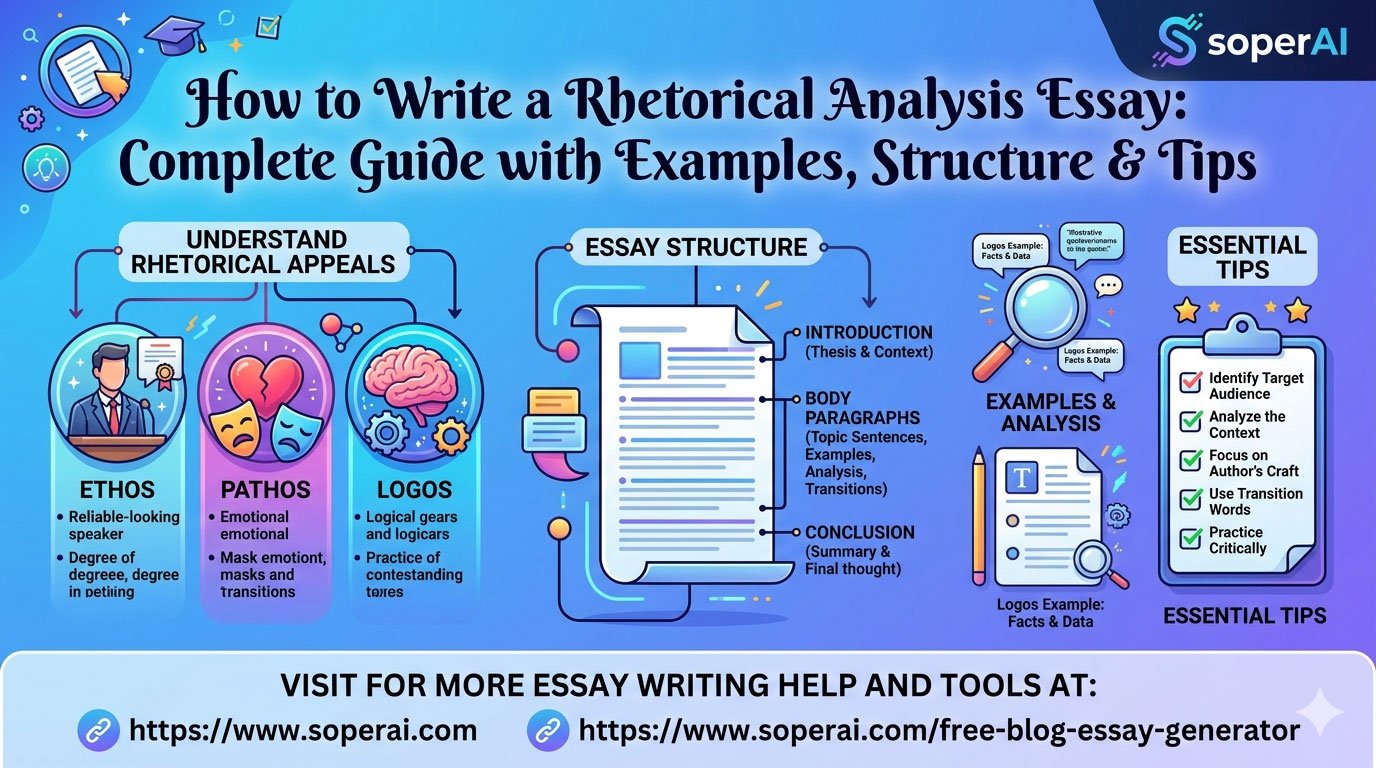
At the core of virtually every rhetorical analysis is Aristotle's three appeals — ethos, pathos, and logos — introduced in his foundational work Rhetoric around 350 BCE. These three modes of persuasion remain the primary analytical categories in rhetorical analysis today, more than 2,300 years after Aristotle first described them. Understanding them deeply is non-negotiable for any serious rhetorical analysis.
Ethos
Ethos is the appeal to the author's credibility, trustworthiness, and authority. When a writer establishes ethos, they are persuading the audience to trust them as a reliable, knowledgeable, and morally credible source.
Pathos
Pathos is the appeal to the audience's emotions, values, and imagination. When a writer deploys pathos, they are using emotionally resonant language, imagery, and narrative to make the audience feel something that aligns with the argument.
Logos
Logos is the appeal to reason, logic, and evidence. When a writer uses logos, they are supporting their argument with facts, statistics, expert testimony, logical deductions, and empirical data that the audience can rationally evaluate.
How the Three Appeals Work Together
The most effective communicators rarely rely on just one appeal. A powerful speech, for example, might open with ethos (establishing the speaker's authority and shared identity with the audience), build through logos (marshaling facts and logical arguments), and reach its emotional climax through pathos (a vivid story that makes the abstract concrete and personally felt). Analyzing how a text combines these appeals — and when it switches from one to another — is where the richest rhetorical analysis usually lives.
| Appeal | Questions to Ask | What to Look For | Common Weaknesses |
|---|---|---|---|
| Ethos | Why should the audience trust this author? | Credentials, tone, acknowledgment of complexity, source quality | Fallacious appeals to authority, inconsistent persona |
| Pathos | What emotions does this evoke? Why? | Word choice, imagery, anecdotes, rhetorical questions | Emotional manipulation without evidence, sentimentality |
| Logos | Is the reasoning sound and evidence valid? | Statistics, studies, analogies, logical structure | Logical fallacies, cherry-picked data, correlation vs. causation |
4The SOAPSTone Method: Your Pre-Writing Framework
Before you write a single sentence of your essay, you need to thoroughly analyze the text you are examining. The SOAPSTone method — developed as a teaching tool for AP Language courses — provides a systematic, seven-part framework for doing exactly that. Working through each element of SOAPSTone before drafting ensures that your analysis is comprehensive and that your essay addresses all the relevant contextual factors that shape the text's rhetoric.
First S
Who is the author? What is their background, identity, and perspective? What persona do they project within this specific text?
O
What is the time, place, and circumstance that prompted this text? What historical or cultural moment does it emerge from?
A
Who is the intended audience? What assumptions does the text make about its readers? Are there secondary or unintended audiences?
P
What does the author want the audience to think, feel, believe, or do? What is the text's explicit or implied goal?
Second S
What is the text explicitly about? What topic or issue does it address? (This is often simpler than the purpose.)
T
What is the author's attitude toward the subject and audience? How does this tone shift throughout the text, and why?
The "one"
What is the deeper underlying message or central insight the text conveys beyond its surface subject?
5Rhetorical Analysis Essay Structure
A rhetorical analysis essay follows a clear, recognizable structure. Unlike creative essays where structure can be experimental, a rhetorical analysis benefits from a conventional academic framework — because the clarity of your structure reflects the clarity of your analysis. Here is the standard structure used in AP Language courses and college-level writing programs:
-
Introduction ParagraphIntroduce the text being analyzed (author, title, date, publication context). Provide essential background on the occasion and audience. State your thesis — a claim about the text's overall rhetorical effectiveness and the primary strategies the author employs to achieve their purpose. Do not summarize the text; orient the reader to the analysis.
-
Body Paragraph 1 — First Rhetorical StrategyIdentify a specific rhetorical appeal or device. Provide a direct quotation or specific textual evidence. Explain how the strategy works and why the author chose it. Evaluate its effectiveness for the intended audience and purpose.
-
Body Paragraph 2 — Second Rhetorical StrategyFollow the same identify-explain-evaluate structure for a second strategy. Ideally, this paragraph addresses a different appeal (e.g., if paragraph 1 focused on ethos, paragraph 2 might focus on pathos). Show how the strategies interact or build on each other.
-
Body Paragraph 3 — Third Rhetorical Strategy (or Deeper Analysis)A third body paragraph allows you to address logos, a specific structural choice, or a pattern of rhetorical devices across the text. Alternatively, use this paragraph to analyze how the text's strategies shift or evolve, or to address the text's limitations and where strategies fall short.
-
Conclusion ParagraphRestate your thesis in new language that reflects the full analysis you have built. Synthesize how the strategies work together to serve the author's overall purpose. Offer a final evaluative judgment: does the text achieve its rhetorical goals effectively? Why or why not? Avoid introducing new evidence; conclude the analytical argument you have made.
6Step-by-Step: How to Write a Rhetorical Analysis Essay
Now that you understand the conceptual foundations — the three appeals, the SOAPSTone framework, and the essay structure — we can walk through the complete writing process from first read to final draft. Follow these six steps methodically and you will produce a rigorous, confident rhetorical analysis every time.
Read the Text Actively — Annotate with Purpose
Your first reading of the text should be a careful, active, annotated reading. Do not just read for comprehension — read with a rhetorical lens. Use a pen or digital annotation tool to mark every moment where you notice the author making a deliberate choice. Underline emotionally charged language. Circle statistics and evidence. Put a star next to moments where the author seems to be directly addressing or appealing to the audience's values. Note shifts in tone with a simple T+arrow.
Read the text at least twice before you begin analysis. Your first reading gives you comprehension. Your second reading, armed with your SOAPSTone questions, gives you your raw analytical material. If the text is a speech, watch or listen to it if possible — delivery, pacing, and emphasis are rhetorical choices too, and they matter to a complete analysis.
Complete Your SOAPSTone Analysis
With your annotated text in hand, work through each SOAPSTone element deliberately and write your answers in full sentences. This is not busywork — these seven answers are the intellectual infrastructure of your entire essay. Your thesis will emerge from your answers to Purpose and Tone. Your body paragraph topics will emerge from your answers about the dominant strategies you noticed during annotation.
Pay particular attention to the relationship between Occasion and Audience. A speech delivered to a hostile audience requires different rhetorical choices than one delivered to a sympathetic crowd. A text written during a national crisis calls on different emotional registers than one written during peacetime. Understanding the occasion illuminates why the author made the choices they did — and that "why" is the heart of rhetorical analysis.
Write a Strong, Specific Thesis Statement
Your thesis is the analytical backbone of your entire essay — and it must be more specific than "The author uses ethos, pathos, and logos to persuade the audience." That template thesis tells the reader nothing meaningful, because every persuasive text uses all three appeals. A strong thesis identifies the specific strategies the author prioritizes, explains how they use them, and makes a claim about how effectively they serve the author's purpose.
Weak thesis: "In her speech, Michelle Obama uses ethos, pathos, and logos to appeal to her audience."
Strong thesis: "In her 2016 DNC speech, Michelle Obama establishes unassailable moral credibility through personal maternal narrative, then deploys emotionally resonant contrast between her children's protected childhood and the precariousness of American opportunity to argue that political leadership is, at its core, a question of character — a strategy that proves remarkably effective precisely because it sidesteps partisan division entirely."
Draft Each Body Paragraph Using the PEEL or TEA Framework
Each body paragraph should follow a consistent internal structure. Two frameworks work well for rhetorical analysis body paragraphs. The TEA framework (Technique → Evidence → Analysis) instructs you to name the rhetorical technique, provide specific textual evidence, and then analyze how and why the technique works. The PEEL framework (Point → Evidence → Explanation → Link) adds an explicit link back to your thesis at the end of each paragraph.
Whichever framework you use, the most important element is the analysis sentence — the sentence that explains why the author's choice works on the intended audience. This is the sentence most students rush through or skip entirely, and it is also the sentence that most differentiates a basic analysis from an excellent one. Spend proportionally more time on the analysis than on the evidence quotation.
Write the Introduction and Conclusion Last
As with all analytical essays, your introduction and conclusion are best written after your body paragraphs are complete. Why? Because your body paragraphs contain the actual analysis — the substance of what you are arguing. Once that substance is written, you know exactly what your introduction needs to promise and what your conclusion needs to synthesize. Writing these framing paragraphs first often results in an introduction that promises things the essay never quite delivers, or a conclusion that simply repeats the introduction.
Your introduction should briefly contextualize the text (SOAPS information), set up the analytical angle, and end with your thesis. Your conclusion should synthesize — not simply summarize — by explaining how the rhetorical strategies you analyzed work together and what that combination tells us about the text's overall effectiveness. End with a statement about the broader significance of the text's rhetorical choices.
Revise for Analytical Depth, Not Just Grammar
The most important revision pass in a rhetorical analysis essay is an analytical depth check — not a grammar check. Read through your essay and ask: Is every paragraph doing real analytical work, or am I just describing what the author said? Is my thesis claim present and reinforced throughout? Have I explained why each strategy works, not just that it works? Is every quotation analyzed, or have I left some evidence without explanation?
A useful revision test: cover your analysis sentences and read only the evidence. Could the reader draw any conclusion from the evidence alone? If yes, your analysis is probably too thin — you are letting the text speak for itself rather than doing the analytical work of explaining its rhetoric. Your voice, your analysis, your argument should be the driving force of the essay, with textual evidence serving as support rather than substance.
7Rhetorical Analysis Examples: Strong vs. Weak
The gap between a mediocre rhetorical analysis paragraph and an excellent one is almost always in the analysis — not the evidence. The following examples illustrate this dramatically. Both analyze the same moment from the same text; only the quality of the analytical work differs.
Analyzing a Passage from Martin Luther King Jr.'s "Letter from Birmingham Jail"
❌ Weak Rhetorical Analysis Paragraph
- "In his 'Letter from Birmingham Jail,' Martin Luther King Jr. uses pathos to appeal to his audience. He describes the experiences of African Americans who face injustice. He talks about children and how they are affected. This makes the reader feel sad and sympathetic. King uses emotional language throughout the letter to persuade the white clergymen to support the civil rights movement."
Why it fails: Describes pathos without analyzing it. No specific quotation. No explanation of why the specific choice works on this specific audience. "Makes the reader feel sad" is not rhetorical analysis — it is an emotional reaction report.
✅ Strong Rhetorical Analysis Paragraph
- "King's most strategically precise use of pathos arrives when he invites the clergymen to imagine their own children asking questions they cannot answer: 'when you have seen the vicious mobs lynch your mothers and fathers at will and drown your sisters and brothers at whim… then you will understand why we find it difficult to wait.' By forcing his highly educated, nominally compassionate audience into the experiential position of Black fathers and mothers, King dismantles their ability to theorize about patience and gradual progress from a safe distance. The syntax — a long accumulating series of 'when you have seen' clauses — mirrors the relentless accumulation of injustice itself, making the argument structurally as well as emotionally inescapable."
Why it works: Specific quotation, precise identification of technique, analysis of why it works on this specific audience, discussion of syntax as a rhetorical choice, sophisticated vocabulary throughout.
Full Thesis Examples for Common Rhetorical Analysis Texts
Weak: "Kennedy uses rhetorical devices to make his speech compelling to the American people."
Strong: "Through the disciplined deployment of antithesis and anaphora, Kennedy constructs a rhetoric of shared global obligation that simultaneously elevates his audience into agents of world history and frames American democratic idealism as the singular moral force capable of confronting communist expansion — a strategy that transforms a domestic political speech into a foundational document of Cold War American identity."
Truth's most subversive rhetorical move is her deployment of embodied ethos — credibility established not through formal education or institutional authority, which she explicitly lacked, but through the physical testimony of her own body. "Look at me! Look at my arm!" she reportedly declared, baring her arm to the crowd. By making her own physical history — a history of enslaved labor, of children sold away, of survival — the primary evidence in her argument, Truth inverts the conventional hierarchy of rhetorical authority. The learned male abolitionists and clergymen in the audience possessed institutional credibility; Truth possessed something more fundamentally persuasive: irrefutable embodied witness. Her ethos cannot be debated or discredited by those without equivalent experience.
8Key Rhetorical Devices You Must Know
Beyond the three core appeals, skilled rhetorical analysis requires familiarity with the specific rhetorical devices authors use to structure, ornament, and intensify their arguments. The following table covers the most commonly encountered and analytically significant devices you will need to identify and discuss:
| Device | Definition | Example | Rhetorical Effect | Appeal |
|---|---|---|---|---|
| Anaphora | Repetition of a word or phrase at the start of successive clauses | "I have a dream… I have a dream…" | Creates rhythm, emphasis, and emotional momentum | Pathos |
| Antithesis | Juxtaposition of contrasting ideas in parallel structure | "Ask not what your country can do for you…" | Creates memorable contrast; forces either/or thinking | Logos |
| Rhetorical Question | A question posed for effect, not requiring an answer | "Ain't I a Woman?" | Draws the audience into the argument; implies obvious answer | Pathos |
| Allusion | Indirect reference to a person, place, event, or text | Referencing the Bible in a political speech | Borrows authority; creates shared cultural meaning | Ethos |
| Metaphor / Extended Metaphor | Implicit comparison between unlike things | "America has given the Negro a bad check" | Makes abstract concrete; creates visceral understanding | Pathos |
| Analogical Reasoning | Using a familiar comparison to explain an unfamiliar argument | Comparing a new policy to a historical precedent | Makes complex arguments accessible and logical | Logos |
| Juxtaposition | Placing two contrasting elements side by side | Describing luxury and poverty in adjacent sentences | Heightens contrast; creates moral urgency | Pathos |
| Concession and Refutation | Acknowledging opposing views before dismantling them | "While critics argue X, the evidence shows Y" | Builds ethos through perceived fairness; strengthens argument | Ethos |
| Diction | Deliberate word choice for specific effect | "Massacre" vs. "incident" vs. "altercation" | Frames the reader's perception of events and people | Pathos |
| Kairos | Appeal to the timeliness and appropriateness of the moment | Citing a recent tragedy in a policy argument | Creates urgency; connects argument to lived present | Kairos |
9Common Mistakes to Avoid in Rhetorical Analysis
Even analytically capable students make predictable, avoidable mistakes in rhetorical analysis essays. Knowing these pitfalls before you write is the most efficient form of preparation:
-
⚠️
Writing a Summary Instead of an Analysis
The most common mistake in rhetorical analysis is spending paragraph after paragraph retelling what the text says. If your essay is more than 20% summary, it is too much. Every sentence should be doing analytical work — explaining how the text works, not what it says. As a self-check: if you could write the same paragraph without reading the text carefully, it is probably summary, not analysis. -
⚠️
Writing a Generic "Ethos, Pathos, Logos" Essay
The three-paragraph formula of "Paragraph 1: ethos. Paragraph 2: pathos. Paragraph 3: logos." produces the weakest rhetorical analysis essays. Sophisticated analysis does not sort appeals into separate buckets — it examines how they overlap, interact, and shift. The richest analyses examine how a single passage simultaneously deploys multiple appeals or how the text's structure itself is a rhetorical choice. -
⚠️
Agreeing or Disagreeing with the Argument
Rhetorical analysis is not an invitation to share your opinion on the topic the text addresses. Your personal view of climate change, gun control, or immigration is irrelevant to a rhetorical analysis of a text about those topics. If you find yourself writing "I agree with the author because…" or "The author is wrong about…" — stop. Redirect your paragraph to the analytical question of how the argument is constructed, not whether it is correct. -
⚠️
Leaving Quotations Unanalyzed (The "Hit and Run" Quote)
Dropping a quotation from the text and immediately moving to your next point — without analyzing the quotation — is one of the most reliable ways to produce a superficial rhetorical analysis. Every quotation you include must be followed by analysis that explains what rhetorical work it is doing. If you do not have enough to say about a quotation to write at least two analytical sentences, choose a different quotation or combine evidence more efficiently. -
⚠️
Writing a Vague, Non-Specific Thesis
"The author effectively uses multiple rhetorical strategies to persuade the reader" is not a thesis — it is a statement that could be said about any persuasive text ever written. Your thesis must make a specific claim about which strategies this text employs, how they function, and how effectively they serve this specific purpose with this specific audience. Vague thesis → vague essay. The precision of your thesis sets the ceiling for the precision of your analysis. -
⚠️
Ignoring Audience and Occasion in Analysis
Rhetorical choices only make sense in context. A strategy that is highly effective with one audience might be completely counterproductive with another. A text written at one historical moment may deploy strategies that would be invisible or confusing at a different moment. Always ground your analysis in the specific audience and occasion — they are the standard against which rhetorical effectiveness should be measured.
10Pro Tips for a Top-Scoring Rhetorical Analysis Essay
🎯 Prioritize Analysis Over Coverage
A deep, sophisticated analysis of two or three rhetorical strategies is always more impressive than a shallow mention of six or seven. Choose the strategies that are most central to the text's persuasive work and analyze them with genuine depth. Quality of analysis matters far more than quantity of devices named.
🔬 Use Precise Rhetorical Vocabulary
Develop fluency with the language of rhetoric — anaphora, antithesis, ethos, kairos, juxtaposition, diction, syntax, concession. Precise vocabulary signals analytical credibility. But remember: naming a device without analyzing it earns no credit. The vocabulary is a tool, not a destination.
🔗 Connect Every Point to the Author's Purpose
Every analytical claim you make should connect back to the author's overall rhetorical purpose. Ask yourself at the end of every paragraph: "So what? Why does this matter for the author's goal?" If you cannot answer that question, your analysis has not gone deep enough yet.
📝 Analyze Tone Shifts Deliberately
Many powerful texts deliberately shift tone at key moments — becoming more urgent, more intimate, or more accusatory — and these shifts are among the richest material for rhetorical analysis. Identifying where and why a text's tone changes, and what effect those changes have on the audience, demonstrates sophisticated analytical reading.
📚 Read Strong Models Before You Write
Read published rhetorical analyses — in academic journals, in resources like Purdue OWL and JSTOR — before writing your own. Notice how experienced analysts integrate evidence, frame their claims, and maintain analytical distance. Imitation of strong models is the fastest path to improvement.
🔄 Revise with an Analytical Ruler
After drafting, highlight every sentence that is purely analytical (not summary, not quotation). If the analytical sentences are sparse, your essay needs a revision pass focused specifically on deepening the analysis. Aim for at least two to three original analytical sentences for every quotation you include.
📈 What Graders Look For in a Rhetorical Analysis Essay
⚡ Write Smarter with SoperAI's Free AI Writing Tools
From generating thesis statements to structuring body paragraphs, SoperAI's free AI tools help you write stronger analytical essays — faster, with more confidence.
Writing a rhetorical analysis essay demands a specific kind of intellectual stamina — you must sustain close analytical attention across an entire text, maintain analytical objectivity while working with emotionally charged material, and express sophisticated ideas in precise academic language. AI writing tools have become genuinely useful partners in all three of these challenges.
Here is how writers are practically using AI to strengthen their rhetorical analysis work:
- Thesis generation: AI tools can generate multiple thesis options based on the text and strategies you are analyzing, giving you strong starting points to refine with your own voice and insight.
- Outline building: Use SoperAI's Free Outline Generator to build a structured analytical outline before drafting — ensuring your body paragraphs are logically sequenced and each addresses a distinct rhetorical element.
- Vocabulary suggestions: AI can help you find precise rhetorical vocabulary when you know what a device does but cannot remember its technical name.
- Analysis deepening: If you have written a paragraph you feel is too thin, AI tools can suggest additional analytical angles you may not have considered.
Working on other essay types alongside your rhetorical analysis? Our guide on how to introduce a narrative essay covers the very different craft of personal storytelling introductions — an excellent complement to the analytical skills you are developing here. And for any essay type, the full suite of free AI writing tools at SoperAI has resources that can help at every stage of the writing process. Visit soperai.com to explore everything available.
| Writing Task | Without AI Assistance | With SoperAI Tools |
|---|---|---|
| Drafting a specific thesis | Often takes 30+ min of iteration | Multiple options in seconds |
| Building essay outline | Requires planning expertise | Structured outline instantly |
| Identifying rhetorical devices | Relies on memory of device list | AI flags devices in text |
| Deepening analysis sentences | Hardest part to do alone | Suggested analytical angles |
| Cost | Time and mental energy | Completely free |
11Frequently Asked Questions
Conclusion: Rhetoric Is Everywhere — Learn to See It
Every message you encounter — every advertisement, every political speech, every op-ed, every well-crafted social media post — has been built to move you in some direction. Rhetorical analysis gives you the tools to see that construction clearly, to understand the machinery behind the message, and to evaluate it on its own terms rather than simply being swept along by it.
We have covered the complete landscape of rhetorical analysis essay writing in this guide. You now understand the three core appeals (ethos, pathos, logos) and the fourth (kairos). You have a systematic pre-writing framework in SOAPSTone. You know the standard essay structure and the step-by-step writing process from active reading to final revision. You have seen real examples of strong and weak analysis, learned the key rhetorical devices you need in your vocabulary, and know the six most damaging mistakes to avoid.
Most importantly, you understand the fundamental shift in perspective that rhetorical analysis demands: setting aside your own opinion about the subject and focusing entirely on how the argument works. That shift — from reader to analyst, from persuaded to skeptic, from consumer to critic — is the core intellectual move of the discipline, and it becomes more natural with every analysis you write.
If you are working on a narrative essay alongside your rhetorical analysis, our guide on how to introduce a narrative essay provides a complementary skill set for the personal, story-driven essay form. And whenever you need AI-powered support for any essay type — thesis generation, outline building, or analysis deepening — the tools at SoperAI are free and ready to help.
The best rhetorical analysts are not cynics — they are the most sophisticated readers in the room. Now you are one of them.
✨ Start Writing with Free AI Tools — No Signup NeededCompletely free. Instant results. | Narrative Essay Guide → | Visit SoperAI →