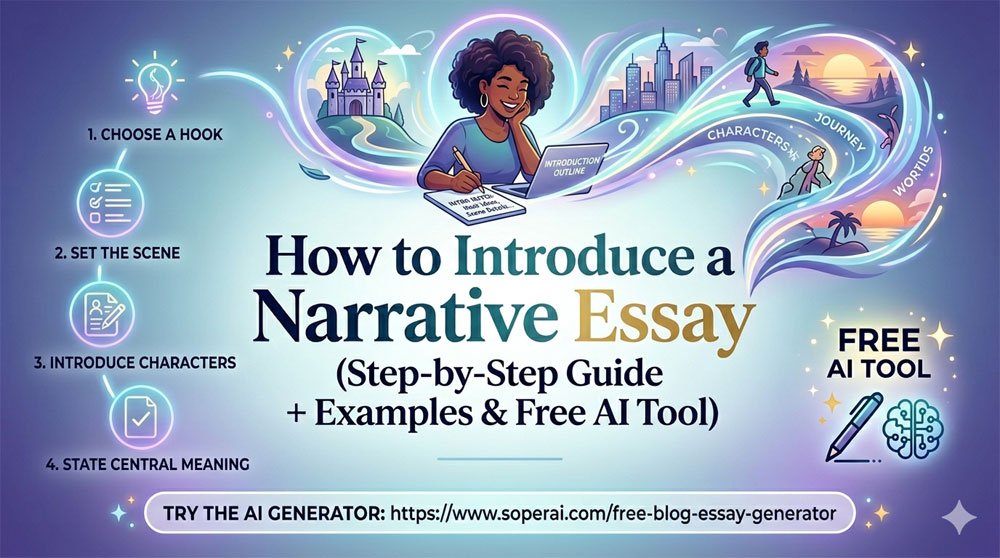
How to Introduce a Narrative Essay
Hooks, Structure, Examples & Free AI Tool
Your opening sentence decides whether readers stay or leave. Learn the proven techniques that make narrative essay introductions impossible to ignore.
- Why Your Introduction Is Everything
- Anatomy of a Narrative Essay Introduction
- 7 Powerful Hook Techniques (With Examples)
- Step-by-Step: How to Write Your Introduction
- Real Introduction Examples (Good vs. Weak)
- Do's and Don'ts: Common Introduction Mistakes
- Introduction Starters for Popular Topics
- Pro Tips from Experienced Essay Writers
- How AI Writes Your Introduction Instantly
- Why Soperai Is the Best Free Essay Tool
- 10 FAQs — Everything You Need to Know
- Conclusion & Your Next Step
Your Introduction Has Eight Seconds to Hook a Reader — Make Them Count
Research in reader psychology consistently shows that people decide within the first few sentences whether a piece of writing is worth their time. For a narrative essay, this pressure is even more acute. Unlike an argumentative essay where readers come for information, narrative essay readers come for an experience — and your introduction is the door through which they enter that experience.
Get the introduction right, and readers lean forward. They want to know what happens, how it ends, and what it meant to you. Get it wrong — with a dull opener, a generic statement, or an overlong backstory — and even the most beautifully crafted body paragraphs may go unread.
The good news? Writing a compelling narrative essay introduction is a learnable skill. There are specific, proven techniques that great writers use every time — and in this guide, you'll master all of them. Whether you're writing a high school assignment, a college application personal statement, or a blog post, this guide will show you exactly how to open your story with confidence and power.
We'll also link you throughout to our complete guide on how to write a narrative essay, where you can learn how to craft every section from body paragraphs to conclusion once your intro is locked in.
What Does a Narrative Essay Introduction Actually Contain?
Before you write a single word, you need to understand what a great narrative essay introduction is made of. It has three distinct parts — each doing a different job — and all three must work together seamlessly.
Part 1 — The Hook
The very first sentence (or two) whose sole purpose is to arrest the reader's attention and make them physically unable to stop reading. This is your most important sentence. It sets the emotional tone, introduces the world of your story, and creates immediate curiosity or empathy.
Part 2 — Background Context
One to three sentences that give readers just enough context to understand the situation without overwhelming them with backstory. Who is involved? When does this story take place? What is the general situation? Answer these questions briefly and efficiently — you'll fill in the details in the body.
Part 3 — The Thesis Statement
The sentence that tells readers why you're sharing this story. Unlike an argumentative essay thesis, a narrative essay thesis is subtle — it hints at the lesson learned, the transformation experienced, or the insight gained. It's the compass that orients everything that follows.
📐 Introduction Blueprint: What Goes Where
| Component | Length | Purpose | Placement | Tone |
|---|---|---|---|---|
| 🪝 Hook | 1–3 sentences | Capture attention immediately | Very first sentence(s) | Dramatic / Vivid |
| 🗺️ Background | 2–4 sentences | Set scene and context | Middle of intro | Informative / Warm |
| 🎯 Thesis | 1–2 sentences | Signal the story's meaning | Final sentence(s) | Reflective / Insightful |
7 Powerful Hook Techniques for Narrative Essay Introductions
A hook is not a single technique — it's a category of opening moves that great writers choose from depending on their story, their audience, and the emotional effect they want to create. Here are seven proven hooks, each with a real example you can model.
📊 Hook Technique Effectiveness Ratings (By Reader Engagement)
*Ratings based on reader-engagement studies from writing workshops and MFA programs.
🎬 In Medias Res — Drop into the Action
The Latin term means "into the middle of things." You skip setup entirely and place readers directly inside a scene at its most intense moment. This is the single most powerful hook technique for narrative essays.
💬 Open with Dialogue
A single line of spoken dialogue instantly creates characters and tension. It drops readers into a conversation mid-stream and creates a compelling sense of immediacy and intimacy.
❓ Ask a Provocative Question
A well-crafted question engages the reader's intellect and creates an implicit promise: if you keep reading, you'll find the answer. The key is making the question specific and intriguing — not vague or rhetorical.
🖼️ Sensory Scene-Setting
Create such a vivid, specific physical environment in your opening that readers feel transported. Use all five senses — not just sight. This works especially well when the setting itself is central to the story's emotional meaning.
💡 Make a Surprising Statement
Open with a claim, observation, or revelation that defies expectation. The surprise creates cognitive dissonance — readers feel compelled to understand how this surprising thing came to be true.
📖 Lead with a Resonant Quote
A carefully chosen quote — from literature, from someone who spoke to you directly, or from your own memory — can establish theme and emotional tone instantly. Avoid famous over-used quotes; seek something specific and unexpected.
🌀 Begin with Reflection
Start from the end of your story, looking back at the experience with hard-won wisdom. This technique works because readers know you survived — and they want to understand how you came to see things so clearly.
How to Write Your Narrative Essay Introduction — Step by Step
Follow these steps in order and you'll go from a blank page to a powerful, reader-grabbing introduction every single time.
Know Your Story's Core Moment Before You Write a Word
You cannot write a great introduction without knowing where your story is going. Before you draft your opening, identify the central moment of your narrative — the scene where everything changes. Your introduction should be written so that it points (subtly) toward that moment. Don't start writing the intro until you know the heart of your story.
Choose Your Hook Technique Based on Your Story's Mood
Match your hook to the emotional register of your narrative. A story about sudden loss might work best with in medias res — dropping readers into the moment of crisis. A story about a gradual realization might work better with a reflective opening. Ask yourself: What emotion do I want my reader to feel in the first ten seconds? Then choose the hook that delivers that emotion most directly.
Draft Your Hook — Then Write Three Versions of It
Never settle for your first hook. Write your opening line, then write two more completely different versions of it using different hook techniques. Read all three aloud. The one that makes the hair on the back of your neck stand up — that's the one to keep. Professional writers often write ten or more opening sentences before they find the right one.
Add Just Enough Background to Orient the Reader
After your hook, provide the minimum context readers need to follow the story. Think of it as zooming out slightly from your dramatic opening scene to show the wider setting. Introduce the "who, where, and when" briefly. Resist the urge to explain everything — save the details for your body paragraphs. Two to four sentences of context is almost always enough.
Close with a Thesis That Hints at Your Story's Meaning
Your final introductory sentence is your thesis. Unlike a traditional argumentative thesis, a narrative essay thesis doesn't state a position — it hints at the lesson, transformation, or insight that the story ultimately delivers. It should feel like a promise: "Keep reading, and you'll understand why this moment mattered." Write it last, after you've drafted the rest of your introduction.
Read It Aloud and Cut Anything That Slows You Down
Read your introduction aloud at a normal speaking pace. Anywhere you stumble, hesitate, or feel the rhythm break — cut or rewrite that sentence. A narrative essay introduction should flow with the momentum of a story being told. If it sounds like a textbook or a list of facts, it's not there yet. Every sentence should propel the reader forward, not pause them.
Narrative Essay Introduction Examples — Weak vs. Strong
The fastest way to improve your own writing is to study both excellent and poor examples side by side. Here are real-world introductions across a range of topics, with annotations explaining exactly what works — and what doesn't.
Example 1 — Topic: Overcoming Fear of Public Speaking
In this essay, I will talk about the time I had to do public speaking and how I was nervous. I have always been scared of speaking in front of people. This experience taught me a lot about overcoming my fears.
My knees were vibrating — not trembling, vibrating — as I climbed the three steps to the stage. Behind me, two hundred people settled into their seats with the casual ease of people who had nowhere more important to be. I had prepared for this moment for six weeks. None of that preparation had included this particular feeling: the vertiginous certainty that I was about to embarrass myself in front of the one teacher who had ever told me I had something worth saying. That night, I learned that courage is not the absence of fear — it is the decision, made in the space between heartbeats, to walk forward anyway.
Example 2 — Topic: Learning from a Grandmother
My grandmother was a very important person in my life. She taught me many things when I was young. This essay is about a memory I have with her that changed my perspective on life.
My grandmother kept a jar of raw cardamom pods on the windowsill above the kitchen sink, and she would crack one open whenever she thought no one was watching — just to smell it, she said, not to use it. She had been doing this for as long as anyone in the family could remember. It was only after she died that I understood she wasn't smelling the spice at all. She was travelling back to a village in Punjab that no longer existed, through the only door still open to her: memory. That jar sits on my windowsill now.
Example 3 — Topic: Moving to a New Country
"You'll make friends," my mother said, pressing a cheese sandwich into my hand on the first day of school in a country where I didn't yet know how to ask where the bathroom was. I nodded. I did not believe her. I was eight years old and I was carrying, folded in my school bag, a map of Karachi that my father had drawn from memory — streets, landmarks, the bakery on Hassan Ali Street where we used to buy bread on Sunday mornings. The map was wrong in a dozen places, but that didn't matter. It was proof that somewhere, the city I understood still existed. That year, I learned that home is not a place you leave — it's a place you carry.
Common Introduction Mistakes — and What to Do Instead
Even strong writers make these mistakes in their first drafts. The difference between a good essay and a great one is often catching and fixing these issues in revision.
✅ DO These Things
- Start with a specific, concrete scene or image
- Use first-person voice ("I," "my," "me") naturally
- Create curiosity or emotional tension from sentence one
- End your intro with a subtle, reflective thesis
- Keep your introduction focused (5–8 sentences max)
- Use sensory language that places readers in the moment
- Write multiple versions of your hook before choosing
- Read your introduction aloud before finalizing
❌ DON'T Do These Things
- Start with "In this essay, I will tell you about..."
- Open with a dictionary definition ("Merriam-Webster defines courage as...")
- Summarize your entire story in the introduction
- Use vague language ("very important," "a lot," "changed my life")
- Begin with "I was born in..." or "Ever since I was little..."
- Use a generic famous quote (Gandhi, Einstein, etc.)
- Write your thesis as a statement of fact ("This essay shows...")
- Make your introduction longer than your body paragraphs
🔍 Specific Opening Lines — Rated
| Opening Line | Technique | Rating | Why? |
|---|---|---|---|
| "In this essay, I will discuss my experience of moving abroad." | Announcement | ❌ Avoid | Kills momentum immediately; removes all mystery |
| "According to Merriam-Webster, a journey is defined as..." | Dictionary definition | ❌ Avoid | Cliché, impersonal, and delays the story |
| "My life changed the day I moved to a new country." | Vague statement | ⚠️ Weak | Too broad; could describe millions of people |
| "Have you ever felt completely alone in a crowded room?" | Provocative question | 🔵 Decent | Creates empathy but slightly clichéd phrasing |
| "My mother was crying when the movers carried out the last box." | In medias res / visual | ✅ Strong | Specific, visual, emotionally immediate |
| "'Don't look back,' my father said — but I already was." | Dialogue + tension | ⭐ Excellent | Creates character, conflict, and curiosity in 11 words |
| "The last thing I packed was a photograph I no longer recognized myself in." | Surprising statement | ⭐ Excellent | Unexpected, mysterious, rich with implied meaning |
Introduction Starters for 10 Popular Narrative Essay Topics
Use these as inspiration — not verbatim copies. The goal is to see how the techniques work across different topics, then apply the same approach to your own specific story.
| Topic | Hook Type | Sample Opening |
|---|---|---|
| 🎓 First day at a new school | In Medias Res | "The cafeteria was exactly as loud as I had feared, and every table looked full in a way that wasn't about seats." |
| 💔 A friendship that ended | Dialogue | "She said 'I think we've grown apart' the way people say things they've been rehearsing for months — carefully, and without looking up." |
| 🏅 Winning (or losing) a competition | Sensory Detail | "The gymnasium went silent the exact moment my name was not called — a silence so specific and personal that I felt it in my teeth." |
| ✈️ Travelling alone for the first time | Surprising Statement | "I got on the wrong train at 11:47 PM in a city where I didn't speak the language, and it was the best mistake I ever made." |
| 🏥 A health challenge | In Medias Res | "The doctor said 'we'll need to run more tests' in the same voice he used to ask about the weather, and I understood that the world had just divided into before and after." |
| 🐶 Losing a pet | Reflection | "I know now that grief does not arrive all at once. It arrives in small, ordinary moments — when you catch yourself about to call a name that can no longer answer." |
| 🎨 Discovering a passion | Sensory Opening | "The first time I held a paintbrush, I was nine years old and it was covered in someone else's blue, and something in me shifted — quietly, and without permission." |
| 👨👩👧 A family tradition | Specific Detail | "Every Eid morning for thirty years, my grandmother made the same mistake: she always forgot to buy enough bread, and someone always ran to the bakery, and she always pretended to be surprised." |
| 🌍 Cultural identity | Question | "When someone asks me where I'm from, I have learned to answer with whichever city is most convenient — because the real answer takes more time than either of us has." |
| 📚 A book or teacher that changed you | Dialogue | "'You're not reading to remember the plot,' Mr. Ansari told me, sliding the book back across the desk. 'You're reading to find out what you already believe.'" |
8 Pro Tips for a Narrative Essay Introduction That Readers Remember
These are the techniques that separate published writers from struggling students — and most of them take less than five minutes to apply.
Write the Introduction Last
Many great writers draft the body and conclusion first, then return to write the introduction. Once you know where your story goes, you can write a much more precise and resonant opening.
Match Tone to Story
A playful hook for a tragic story creates jarring dissonance. Your introduction's emotional register should match — or intentionally contrast with — the overall tone of your narrative.
Specificity Is Your Superpower
"A summer morning" is generic. "The third morning of August, when the air still smelled like last night's rain" is alive. Replace every general noun with the most specific version available.
Cut Your First Sentence
A surprising trick: delete the first sentence of your introduction draft and see if the second sentence is actually stronger. Writers often bury their best line under a warm-up sentence they didn't need.
Read It Aloud Twice
Read it once for rhythm and flow — if it sounds choppy, rewrite the choppy part. Read it a second time imagining you're hearing it for the very first time. Does it make you want to know more?
Test It on One Other Person
Read just your introduction to a friend, family member, or classmate — then stop. Ask them: "Do you want to know what happens next?" If the answer isn't an immediate yes, revise.
Keep It Under 150 Words
The most powerful narrative essay introductions are tight — typically 80 to 150 words. Every extra sentence you add dilutes the impact of the ones already there. When in doubt, cut.
Plant a Seed for Your Conclusion
Include one image, phrase, or detail in your introduction that you'll return to in your conclusion. This circular structure gives your essay a satisfying sense of wholeness and intentional craft.
How AI Writes Your Narrative Essay Introduction in Seconds
Writing the perfect introduction requires a specific combination of creativity, technique, and craft — all of which can take years to develop. AI tools like the Soperai Essay Generator can shortcut this process dramatically, producing structured, compelling introductions that you can then personalize with your own specific memories and voice.
Instant Hook Generation
Can't find the right opening line? AI generates five different hook options for your topic — in medias res, dialogue, sensory description, surprising statement, and more — in under 30 seconds.
Complete Intro Structure
AI doesn't just write a hook — it builds the entire introduction with properly sequenced hook, background context, and a narrative thesis statement, all in one go.
Multiple Variations
Don't like the first draft? Regenerate with a different tone, a different hook technique, or a different emotional emphasis. AI lets you iterate rapidly without starting from scratch each time.
Topic-Specific Language
AI tailors the vocabulary, tone, and imagery to match your specific topic — so an essay about grief sounds different from one about adventure, even with the same structural template.
✨ Generate Your Narrative Essay Introduction — Instantly
Type your topic and get a complete, hook-first introduction with background and thesis — free, no account needed, results in under 60 seconds.
🚀 Write My Introduction Now 📖 Full Essay Writing GuideWhy Thousands of Students Choose the Soperai Essay Generator
From high school essays to college application statements, Soperai has helped thousands of writers get past the blank page and into a complete, polished draft — fast.
Completely Free
No subscription. No credit card. No hidden fees. Generate as many essays as you need.
Under 60 Seconds
Enter your topic and get a complete introduction — hook, background, thesis — in moments.
Student-Optimized
Built specifically for the kind of essays students actually write: personal, academic, application.
No Account Needed
Just visit the page, type your topic, and write. No sign-up, no email, no friction.
Your Voice, Amplified
The AI creates the structure; you add your personal memories, details, and perspective.
Works for Any Topic
From overcoming failure to cultural identity — the tool adapts to the emotional tone of your story.
| Feature | Soperai | ChatGPT Free | Grammarly | Jasper AI |
|---|---|---|---|---|
| Narrative Essay Specialization | ✓ Dedicated | Requires Prompting | ✗ Grammar Only | Partial |
| Free to Use | ✓ 100% Free | Limited Free Tier | Freemium | Paid Only |
| Hook + Thesis Built-in | ✓ Automatic | Manual Setup | ✗ Not Available | Partial |
| No Login Required | ✓ Yes | Account Required | Account Required | Account Required |
| Speed | < 60 seconds | 2–3 minutes | Editing Only | ~90 seconds |
10 FAQs — Everything About Narrative Essay Introductions
These are the questions most students and writers ask when learning how to introduce a narrative essay — answered in detail for rich snippet ranking.
Your First Sentence Is Waiting to Be Written
Every powerful narrative essay begins with a single, carefully crafted sentence — one that grabs your reader by the collar and refuses to let go. That sentence is not written by accident. It is chosen deliberately, from a range of techniques, with full knowledge of the story it's opening.
You now have everything you need to write it. Let's recap the key principles:
- ✓ A narrative essay introduction has three parts: hook, background context, and a reflective thesis.
- ✓ There are seven proven hook techniques — choose the one that matches your story's emotional tone.
- ✓ Specificity, sensory detail, and momentum are the hallmarks of a great narrative opening.
- ✓ Never start with "In this essay, I will..." — always drop readers into a scene, question, or revelation.
- ✓ Write your introduction last, after you know the full arc of your story.
- ✓ AI tools like Soperai can generate a complete, structured introduction in under 60 seconds — for free.
Now go write your opening line. Write three versions of it. Read them aloud. Choose the one that gives you chills. Then build the rest of your essay around it. And if you want a running start — let AI do the first draft so you can focus on making it yours.
Also explore: Soperai Home · Free AI Tools · Essay Generator · Full Narrative Essay Guide · Purdue OWL · UNC Writing Center