How to Write a Synthesis Essay
Complete Guide with Structure, Examples & Expert Techniques
Master the art of weaving multiple sources into one powerful, original argument — the core skill behind AP Lang success, college-level writing, and professional research.
1Introduction — What Is a Synthesis Essay & Why It Matters
Imagine you are standing in the middle of a heated public debate. Five speakers have each made compelling points from different angles — one citing statistics, another sharing a powerful personal story, a third quoting a respected authority, a fourth raising an ethical objection, and a fifth proposing a practical solution. A good listener absorbs all of that. A great thinker does something more: they find the thread connecting all five perspectives, identify where they converge and where they conflict, and synthesize everything into an original, coherent argument that the debate itself never quite arrived at.
That is precisely what a synthesis essay asks you to do on paper. It is one of the most intellectually demanding — and most rewarding — essay forms in academic writing. Unlike a simple research paper where you collect and report information, or an argumentative essay where you defend a position using your own logic, a synthesis essay requires you to read multiple sources critically, extract their key ideas, and weave those ideas together into an original argument that is yours — supported by, but not defined by, the sources you use.
"Synthesis is not the mere mixing of sources — it is the act of building something new from what others have built before you." — Adapted from Gerald Graff & Cathy Birkenstein, They Say / I Say, 4th Edition
Students encounter synthesis essays most prominently in AP Language and Composition exams, where the synthesis question is one of three free-response essays. But the skill extends far beyond any single test. Every research paper, policy brief, literature review, and consulting report is fundamentally an act of synthesis. Professionals who can read widely, think critically, and write coherently across multiple perspectives are among the most valuable contributors in any field.
This comprehensive guide will walk you through every element of the synthesis essay — from understanding its structure and types to writing a precise thesis, integrating sources with skill, and avoiding the most common mistakes. You will see real examples of strong and weak synthesis writing, learn the transitional techniques that make synthesis arguments flow, and discover how tools like SoperAI's Free Essay Generator can help you get started faster. If you are also developing your broader essay toolkit, our guide on how to write a rhetorical analysis essay is an excellent complement — rhetorical analysis and synthesis are two of the three pillars of AP Language writing.
📊 Synthesis Essay: The Big Picture
2What Is a Synthesis Essay? Definition & Key Concepts
A synthesis essay is an academic paper in which you develop an original argument or explanation by drawing on, analyzing, and integrating multiple source texts. The word "synthesis" comes from the Greek synthesis, meaning "composition" — specifically, the act of combining separate elements into a new unified whole. That etymological root captures the essay's essence perfectly: you are not listing what sources say, you are composing something new from the material they provide.
The fundamental distinction that separates synthesis from other research-based writing is this: in a synthesis essay, the sources serve your argument — your argument does not serve the sources. Your original thesis drives every paragraph. Each source you bring in is evaluated, positioned, and used specifically because it contributes evidence, context, or counterpoint to the argument you are constructing. Sources that do not serve your argument do not belong in the essay, no matter how interesting they are in isolation.
Integration
Combining ideas from multiple sources into a single, unified analytical argument that transcends any one source.
Original Argument
Your thesis must be yours — a claim that the sources inform and support, but do not simply state for you.
Critical Evaluation
You must assess sources — their credibility, perspective, and relevance — not accept them uncritically.
Conversation Between Sources
The best synthesis shows sources in dialogue — agreeing, disagreeing, complicating each other's claims.
Synthesis Essay vs. Other Essay Types
| Essay Type | Central Task | Use of Sources | Your Original Argument | AP Lang Counterpart |
|---|---|---|---|---|
| Synthesis Essay | Build original argument from multiple sources | 3+ sources integrated throughout | Central and driving | Synthesis FRQ |
| Rhetorical Analysis | Analyze how one text persuades | One primary text analyzed | Analytical claim about text | Rhetorical Analysis FRQ |
| Argumentative Essay | Defend a position with evidence | Optional; self-generated evidence | Core purpose | Argument FRQ |
| Research Paper | Investigate a topic using sources | Many sources reported | Present but secondary | — |
| Summary Essay | Report what sources say | Sources drive content | Absent | — |
3Types of Synthesis Essays
Not all synthesis essays are built the same. Understanding the type of synthesis you are being asked to write is the first step to approaching it correctly — because the type determines your thesis, your relationship to sources, and the overall argumentative stance of the essay.
Argumentative Synthesis
The most common type in academic writing and AP Language. You take a clear position on a debatable issue and use multiple sources as evidence to support, complicate, and defend your claim. You are not just reporting what sources say — you are marshaling them in service of your argument.
Explanatory Synthesis
Rather than arguing for a position, an explanatory synthesis presents information from multiple sources to give the reader a comprehensive, balanced understanding of a complex topic. The goal is illumination rather than persuasion — you synthesize sources to paint a fuller picture than any single source could.
Review Synthesis
Common in academic research, a review synthesis compiles and evaluates existing scholarship on a topic, identifying areas of agreement and disagreement, research gaps, and the evolution of understanding over time. It is both a map of existing knowledge and a critique of its limitations.
Narrative Synthesis
A narrative synthesis weaves source material into a story or narrative arc rather than a conventional argumentative structure. Evidence from sources supports the narrative thread. This form appears in journalism, creative nonfiction, and some humanities disciplines.
4Synthesis Essay Structure: The Blueprint
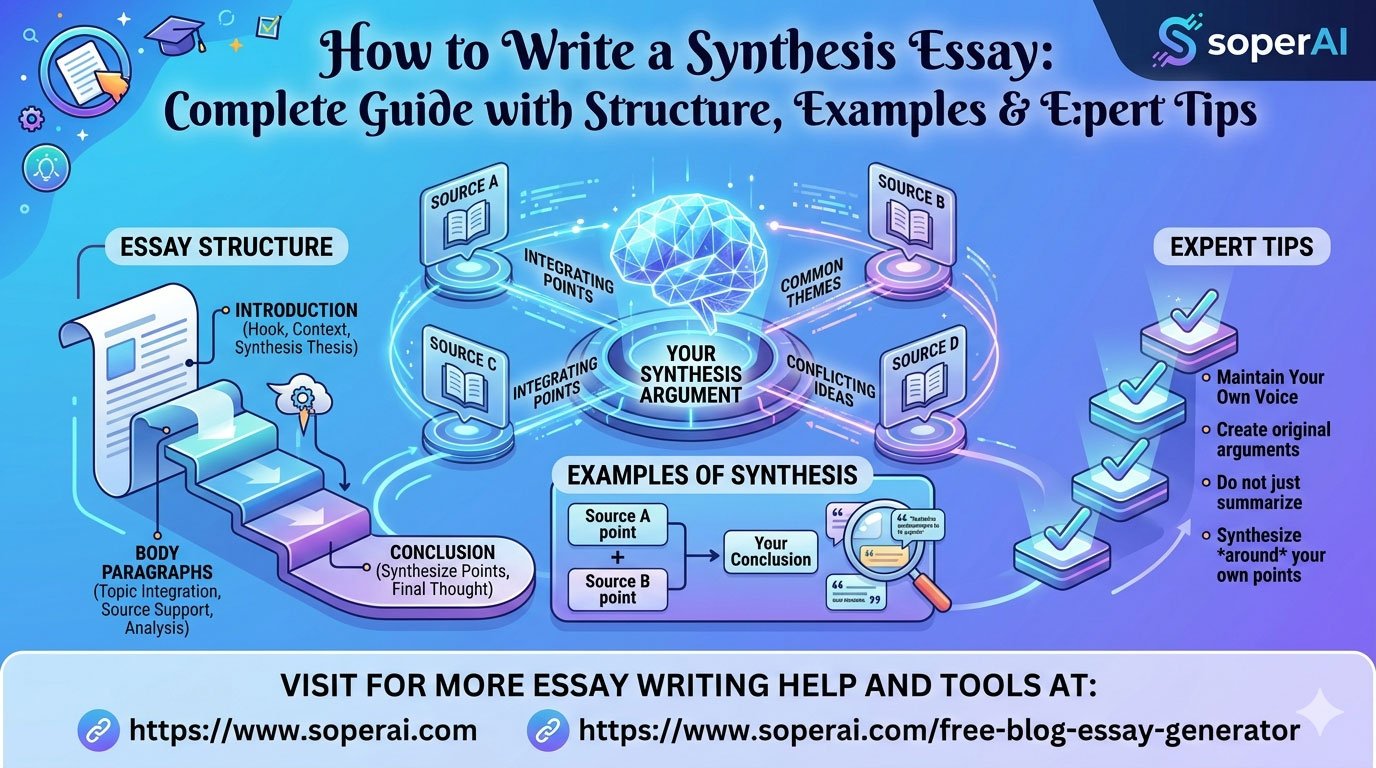
A synthesis essay follows a clear, logical structure that keeps your original argument visible and in control at every stage. The structure is similar to other academic essays but with crucial differences in how you handle source material. Here is the standard blueprint:
-
Introduction ParagraphBriefly establish the topic and its significance (1–2 sentences of context). Introduce the complexity or tension in the issue that your essay will address. End with a clear, specific, defensible thesis that states your original position — not a topic statement, not a question, but a genuine argumentative claim. Do not summarize the sources in the introduction.
-
Body Paragraph 1 — First Major ClaimOpen with a topic sentence that states the first reason, sub-claim, or dimension of your argument. Integrate evidence from at least one (ideally two) sources using quotation, paraphrase, or summary. Analyze the evidence — explain how it supports your claim. Do not let sources speak for themselves; your analysis is the most important element.
-
Body Paragraph 2 — Second Major ClaimAdvance to the next dimension of your argument. This paragraph should use different sources than paragraph 1 where possible, demonstrating the breadth of your synthesis. Include a transitional sentence that connects this paragraph's claim to the previous one, showing logical progression rather than a list of disconnected points.
-
Body Paragraph 3 — Complication, Counterargument, or Third ClaimA strong synthesis essay acknowledges complexity. Use this paragraph to address a significant counterargument, complication, or nuance — then refute, qualify, or integrate it into your argument. Sources that complicate your position are analytically valuable, not threatening. Handling them well demonstrates sophisticated thinking.
-
Additional Body Paragraphs (if needed)For longer college-level papers, add paragraphs that explore additional dimensions of your argument, analyze conflicting sources more deeply, or address different audience perspectives. Each paragraph should advance your thesis — never stray into pure summary or irrelevant tangents.
-
Conclusion ParagraphSynthesize — do not simply summarize. Restate your thesis in new language that reflects the full argumentative journey of your essay. Connect your argument to its broader significance: why does this matter beyond the assignment? What does the synthesis of these sources tell us about the issue, about society, about human experience? End with a memorable closing thought that gives the essay resonance.
5How to Write a Strong Synthesis Essay Thesis
Your thesis is the engine of your entire synthesis essay. Everything else — your choice of sources, your paragraph structure, your analytical moves — exists to support and develop the claim your thesis makes. A weak thesis produces a weak synthesis essay regardless of how good your sources are. A strong, specific, arguable thesis produces a focused, coherent, analytically rigorous essay.
The Synthesis Thesis Formula
Thesis Examples: Weak vs. Strong
Weak Thesis: "Social media has both positive and negative effects on teenage mental health."
Weak Thesis 2: "According to multiple sources, social media can cause depression and anxiety in teenagers."
Strong Thesis: "Although platforms like Instagram and TikTok offer genuine communities for marginalized teenage populations, the algorithmic architecture that maximizes engagement time — rather than meaningful connection — has created a measurable mental health crisis among adolescents that cannot be addressed through individual digital literacy programs alone and demands structural platform regulation."
6How to Find, Evaluate & Integrate Sources
The quality of your synthesis essay depends enormously on the quality of your source integration. This means not just finding credible sources but knowing how to evaluate them critically and weave them into your argument with precision and purpose.
Finding & Evaluating Sources
For college papers, prioritize peer-reviewed academic articles (found through Google Scholar, JSTOR, or your institution's library databases), government and institutional reports, and journalism from reputable outlets. For AP Language exams, sources are provided — but you still need to evaluate them critically rather than accept them at face value.
Use the CRAAP test to evaluate any source: Currency (how recent?), Relevance (how directly does it speak to your argument?), Authority (who wrote it and what are their credentials?), Accuracy (is it evidence-based and verifiable?), Purpose (what agenda might shape its perspective?).
The Four Ways to Integrate Sources
Direct Quotation
Use when the exact wording is uniquely powerful, authoritative, or would lose meaning if paraphrased. Always analyze quoted material — never let quotes speak for themselves. Use sparingly; over-quoting suggests you cannot synthesize.
Paraphrase
Restate a specific idea from a source in your own words and sentence structure. More flexible than quotation — allows you to focus on the specific element of the source's idea that matters for your argument. Must still be cited.
Summary
Condense the overall argument or findings of a source into one or two sentences. Best used to establish what a source generally argues before you engage with a specific element of it. Avoids the trap of dedicating too much space to any one source.
Cross-Source Synthesis
The most sophisticated technique: showing two or more sources in direct conversation — agreeing, disagreeing, or complicating each other — without losing the thread of your own argument. This is what "synthesis" truly means in practice.
| Integration Method | Best Used When | Common Mistake | AP Lang Value |
|---|---|---|---|
| Direct Quotation | Wording itself is the evidence | Over-quoting; no analysis follows | Use sparingly |
| Paraphrase | Idea matters more than wording | Too close to original (plagiarism risk) | Preferred |
| Summary | Establishing source's general position | Too long; becomes a report | Use briefly |
| Cross-Source Synthesis | Showing dialogue between sources | Losing your own argument in the mix | Highest value |
7Step-by-Step: How to Write a Synthesis Essay
With the conceptual framework in place, here is the complete writing process from first contact with the sources to final polished draft. Whether you are working under AP exam conditions or on a college take-home assignment, these seven steps provide a reliable, repeatable process for producing strong synthesis essays.
Read the Prompt Carefully — Understand the Task
Before reading a single source, read the prompt with forensic attention. Identify what the prompt is asking you to do: Does it want you to argue a position? Evaluate a proposal? Examine causes and effects? The prompt contains your assignment, and many students lose points by answering a slightly different question than the one asked. Underline the key verbs (argue, analyze, evaluate, examine) and any specific constraints (must use at least 3 sources, must address counterargument, etc.).
In AP Language conditions, note the specific topic and whether the prompt is asking for your position on a policy question or a more nuanced exploration of tradeoffs. The difference between "argue for or against" and "examine the tensions between" requires significantly different essay approaches.
Read & Annotate All Sources Before Writing Anything
Read every provided source before you write a word of your essay — including your thesis. Why? Because your thesis should emerge from your reading of all the sources, not precede it. As you read each source, annotate actively: mark the main claim or argument, circle key statistics or evidence that strike you as particularly strong, note the author's perspective or potential bias, and flag moments where this source agrees with, contradicts, or complicates another source you have already read.
Create a simple source matrix — a rough grid with each source listed across the top and your main potential argument points down the side. Mark which sources speak to which points. This pre-writing exercise takes eight to ten minutes but will save you significant time during drafting by giving you a clear map of which sources belong in which paragraphs.
Develop Your Original Thesis
With all sources read and annotated, you are now ready to develop your thesis — an original claim that the sources together point toward but do not simply state. Your thesis should emerge from the tension, convergence, and complexity you noticed in the sources. Ask yourself: What do most sources agree on? Where do they diverge, and why does that divergence matter? What position do I now hold on this topic that I can defend with the evidence available?
Write at least two or three thesis drafts before committing to one. Test each draft against the three-question thesis test: Is it arguable? Is it specific? Is it directional? Choose the thesis that is most specific and most clearly supported by the source evidence you have available. Avoid theses that require sources you do not have — always let your available evidence shape your claim.
Create a Source-Mapped Outline
Before drafting, create a paragraph-by-paragraph outline that maps specific sources to specific body paragraphs. Each body paragraph should have: a topic sentence (your sub-claim for that paragraph), the sources you will use as evidence, and a note about the analytical point you will make connecting source evidence to your thesis. This "source-mapped outline" prevents the two most common structural problems in synthesis essays: using sources randomly rather than strategically, and writing paragraphs that feel like lists of source summaries rather than focused argumentative units.
For AP Language conditions, a quick bullet-point outline takes about five minutes but pays off enormously in the coherence and direction of the essay. Even under time pressure, do not skip the outline step.
Draft Body Paragraphs — Argument First, Sources Second
When drafting, begin each body paragraph with your own analytical sentence — your sub-claim — rather than immediately citing a source. This "argument-first" approach keeps your voice and argument in the driver's seat. After your topic sentence, introduce and integrate your source evidence, then analyze how that evidence supports your sub-claim and connects to your thesis. The sequence is: Your claim → Source evidence → Your analysis → Connection to thesis.
When bringing two sources into dialogue within a single paragraph, use transitional language that shows the relationship: "While Source A argues X, Source B complicates this by showing Y — a tension that reveals Z about the broader issue." This is true synthesis: your original analytical observation about the relationship between sources, not just a list of what each says.
Address the Counterargument Strategically
A synthesis essay that only presents evidence supporting your thesis is argumentatively weaker than one that engages seriously with counterevidence. Dedicate at least one body paragraph — or a substantial portion of a body paragraph — to the strongest challenge to your argument. Identify the source that most strongly challenges your position, present its challenge fairly and generously, and then refute, qualify, or integrate it into your argument in a way that ultimately strengthens rather than undermines your thesis.
The key is "strongest challenge." Do not choose a trivial counterargument just to appear balanced — choose the one that a reasonable skeptic of your position would actually raise. Handling a genuinely difficult objection demonstrates analytical maturity and earns significant credit in AP scoring and college grading alike.
Write the Introduction and Conclusion, Then Revise
As with all analytical essays, write the introduction and conclusion after the body paragraphs are drafted. Your introduction should establish the topic's significance, hint at the tension or complexity that makes it worth arguing about, and end with your thesis. Resist the urge to begin with a sweeping generalization ("Since the dawn of time…") or a dictionary definition — both are overused and add nothing. Begin close to the argument: a specific statistic, a concrete scenario, or a precisely framed tension.
Your conclusion should synthesize, not simply summarize. Instead of restating each body paragraph's point, explain what the synthesis of all your evidence and argument collectively reveals about the issue. Then gesture outward: what are the implications? What remains unresolved? What should readers, policymakers, or researchers do with this understanding? A conclusion that opens outward is always more powerful than one that turns inward.
8Full Examples: Strong vs. Weak Synthesis Writing
The gap between a mediocre synthesis paragraph and a strong one nearly always comes down to the same issue: the weak version reports what sources say, while the strong version uses what sources say to make and develop an original argument. The following examples illustrate this with clarity.
Topic: Should colleges eliminate standardized testing requirements?
❌ Weak Synthesis Paragraph (Source Listing)
- "Source A says that SAT scores are biased against low-income students. Source B provides statistics showing that test-optional schools saw increased diversity in their applicant pools. Source C argues that standardized tests are still useful for predicting academic success. Source D talks about how some schools went back to requiring tests after going test-optional. These sources show that standardized testing is a complicated issue with many perspectives."
Why it fails: No original argument. Sources listed sequentially rather than synthesized. No analysis of how sources relate to each other or to a central claim. The concluding sentence is a non-insight — that something is "complicated" tells the reader nothing.
✅ Strong Synthesis Paragraph (Argument-Driven)
- "The most compelling evidence against mandatory standardized testing is not that tests fail to predict academic performance — Source C demonstrates that they do, modestly — but that they predict something else far more reliably: family income. As Source A documents, the correlation between SAT scores and household income is strong enough that the test functions less as a measure of college readiness than as a measure of access to test preparation resources. Source B strengthens this argument with institutional data: when fifteen selective universities moved to test-optional admissions between 2018 and 2022, applications from first-generation college students rose an average of 23%. The implication is not that academic measurement is unnecessary, but that the SAT measures the wrong things — and does so at significant cost to institutional equity."
Why it works: Opens with original analytical claim. Sources are used as evidence for specific sub-points, not listed. Sources are in conversation with each other (Source A and B build together). Ends with original analytical synthesis sentence that advances the thesis.
Full Introduction Example
In 2023, Goldman Sachs estimated that generative AI could automate tasks representing 25 percent of current work activity across the United States economy — a figure that provoked alarm, excitement, and profound confusion in roughly equal measure. The debate over artificial intelligence in the workplace has largely been framed as a binary: technological progress versus worker displacement, efficiency versus human dignity. That framing, however, obscures a more precise and more urgent question: not whether AI will transform work, but whether those transformations will distribute their benefits and costs equitably across the workforce or concentrate them along existing lines of economic inequality. The evidence suggests that without deliberate structural intervention — in education, in labor policy, and in the design of AI systems themselves — the current AI transition is on course to deepen the divide between knowledge workers who direct technology and low-wage workers who are replaced by it.
9Key Synthesis Techniques & Transitional Strategies
The mechanics of synthesis — the sentence-level moves that show sources in dialogue and keep your argument in control — are specific and learnable. The following techniques and transitional strategies are the craft tools of strong synthesis writing:
| Technique | What It Does | Example Phrase | When to Use |
|---|---|---|---|
| Agree & Extend | Two sources agree; you extend the implication | "Both Sources A and C confirm X; taken together, they suggest Y" | When sources reinforce your sub-claim |
| Disagree & Adjudicate | Sources conflict; you determine which is more persuasive and why | "While Source B claims X, Source D's data more convincingly demonstrates Y because..." | When sources contradict; shows analytical judgment |
| Qualify & Nuance | A source partially supports your claim but with important limitations | "Source A supports this claim, though only under the conditions of X, where..." | When evidence is complex or conditional |
| Concede & Pivot | Acknowledge counterevidence before reasserting your claim | "Although Source C raises a valid concern about X, this does not undermine the broader argument that..." | Handling counterargument sources |
| Converge & Synthesize | Multiple sources, approached differently, point to the same conclusion | "Despite their different methodologies, Sources A, C, and E all arrive at the same fundamental insight: X" | When sources from different angles confirm your thesis |
| Gap & Extend | Identify what sources fail to address; your argument fills the gap | "Neither Source B nor Source D accounts for X — a gap that matters because..." | When your argument goes beyond what sources say |
10Common Mistakes to Avoid in a Synthesis Essay
-
⚠️
Writing a "Source Report" Instead of a Synthesis
The most prevalent mistake: organizing the essay around sources rather than around your argument. The telltale sign is body paragraphs that open with "Source A says…" rather than with your sub-claim. Restructure any paragraph that leads with a source attribution rather than your own analytical sentence. Your argument is the spine; sources are the muscles attached to it. -
⚠️
Using Sources as Decoration Rather Than Evidence
Dropping a citation at the end of a paragraph without integrating the source's ideas into your argument is sometimes called "citation stuffing." It is the synthesis equivalent of drive-by sourcing. Every source citation must be followed by analysis that explains what the source's evidence demonstrates and how it supports your specific sub-claim in that paragraph. -
⚠️
Writing a Thesis That Is a Topic Statement
"Social media affects teen mental health" is a topic. "Standardized testing is controversial" is a topic. A thesis must take a specific, defensible position that could be argued against. If your thesis is something everyone agrees with or something that no one could reasonably dispute, it is not a thesis — it is a topic statement in disguise. -
⚠️
Ignoring Sources That Complicate Your Argument
Selectively using only sources that support your position and ignoring challenging ones is not synthesis — it is confirmation bias in essay form. The sources that complicate your argument are often the most analytically valuable because engaging with them demonstrates intellectual honesty and produces more nuanced, defensible claims. Graders at every level reward essays that handle complexity, not ones that avoid it. -
⚠️
Over-Quoting Instead of Synthesizing
A synthesis essay heavy with long direct quotations suggests the writer cannot do the synthesizing work themselves — they are letting the sources do it. As a general rule, direct quotations in a synthesis essay should be brief (one to two sentences maximum) and used only when the specific wording of the source is important. Paraphrase and summary are usually more appropriate because they show you understand and can translate the source's ideas into your own analytical language. -
⚠️
Neglecting to Attribute Sources Clearly
Every piece of source material — quoted, paraphrased, or summarized — must be clearly attributed. In AP Language essays, attribution is typically done by referring to the source directly ("As Source B demonstrates…" or "According to Dr. Jane Smith in Source D…"). In college papers, use the citation format required by your instructor (MLA, APA, or Chicago). Failure to attribute is plagiarism regardless of intent, and unclear attribution makes it impossible for readers to evaluate your evidence.
11Pro Tips for a Top-Scoring Synthesis Essay
🧭 Thesis First, Always
Even under AP exam time pressure, spend at least five minutes developing your thesis before writing. A precise thesis makes every subsequent decision — which sources to use, how to organize paragraphs, which evidence to prioritize — dramatically faster and easier.
🔬 Analyze, Don't Annotate
Your analysis sentences — the sentences where you explain what evidence means for your argument — are more important than the evidence itself. After every source citation, ask "So what? What does this prove about my thesis?" and write two to three sentences answering that question.
🗣️ Maintain Your Voice
The most common sign of a weak synthesis essay is a writer's voice that disappears behind the sources. Use first-person analytical assertions ("This evidence suggests," "The pattern here reveals," "What these sources collectively demonstrate") to keep your argument at the center.
📐 Balance Source Distribution
Spread sources across your essay intentionally. Using four sources in paragraph one and none in paragraphs two and three suggests poor planning. Aim to use different sources in each body paragraph, reserving your strongest source for the paragraph where its evidence has the most impact.
🎯 One Argument Per Paragraph
Each body paragraph should advance exactly one sub-claim of your thesis. If a paragraph is doing two or three things at once, split it. If a paragraph is not clearly advancing any sub-claim, cut it. Disciplined paragraph structure is the single most visible marker of a well-organized synthesis essay.
📚 Study the Rubric
For AP Language, the College Board publishes detailed scoring rubrics and sample essays with commentary for every synthesis prompt. Reading how top-scoring essays are described and evaluated is one of the highest-ROI preparation activities available — more useful than any practice without feedback.
📈 What AP Graders Prioritize in a Synthesis Essay
⚡ Write Your Synthesis Essay Faster with Free AI Tools
From generating thesis options to building source-mapped outlines, SoperAI's free tools help you write stronger, more organized synthesis essays — without wasting hours staring at a blank page.
AI writing tools have become genuinely useful for synthesis essay writers at every level — not as shortcuts around the intellectual work, but as accelerators through the planning and structuring stages where so many writers get stuck. Here is how the tools at SoperAI can support your synthesis essay process:
- Thesis generation: Struggling to formulate a specific, arguable thesis? The SoperAI Free Essay Generator can generate multiple thesis options for your topic, giving you strong starting points to refine and make your own.
- Outline building: Use SoperAI's Free Outline Generator to create a source-mapped essay outline that ensures each body paragraph has a clear argumentative purpose before you begin drafting.
- Source analysis: AI tools can help you identify the key claims of complex sources and suggest how different sources might be put in conversation with each other.
- Transition writing: AI can suggest transitional sentences and paragraph connectors when you know what you want to say but struggle to move smoothly between ideas.
If you are working across multiple essay types — as most AP Language students and college writing students are — our related guides will give you a complete toolkit. Our in-depth guide on how to write a rhetorical analysis essay covers the analytical skills that directly complement synthesis writing. And for building essay structures of any kind, SoperAI's Free Essay Generator is a fast, free starting point. Visit soperai.com to explore the full suite of free writing tools.
| Writing Challenge | Manual Process | With SoperAI Tools |
|---|---|---|
| Developing a specific thesis | Multiple revision cycles; often time-consuming | Multiple options generated instantly |
| Source-mapped outline | Requires planning skill and time | Structured outline in seconds |
| Synthesis transition sentences | Difficult to write naturally under pressure | AI-suggested connectors to adapt |
| Essay introduction | Often the hardest paragraph to start | Draft intro options provided |
| Cost | Hours of your time | Completely free |
12Frequently Asked Questions
Conclusion: Synthesis Is the Highest Form of Analytical Reading
Of all the essay types you will encounter in academic and professional life, the synthesis essay is arguably the most intellectually demanding — and the most intellectually rewarding. It asks you to do what the best thinkers in every field do: read widely and critically, hold multiple perspectives in mind simultaneously, identify the tensions and convergences between them, and construct an original argument that synthesizes all of that material into something new.
We have covered every dimension of the synthesis essay in this guide. You understand what separates synthesis from summary — the non-negotiable centrality of your original argument. You know the four types of synthesis essays and when each applies. You have a clear structural blueprint, a thesis-writing formula, a seven-step process from prompt to final draft, and a toolkit of synthesis techniques for putting sources in productive dialogue. You have seen real examples of strong and weak synthesis writing and know precisely why each succeeds or fails.
You also know the most common pitfalls — source listing, over-quoting, thesis-as-topic, selective use of evidence — and how to avoid every one of them. And you understand that addressing complexity and counterargument is not a threat to your argument but its strongest proof.
If you are developing your full essay toolkit, our guide on how to write a rhetorical analysis essay pairs directly with what you have learned here — together, these two skills cover two of the three AP Language free-response essays and the vast majority of advanced academic writing tasks. And whenever you need a fast, structured starting point for any essay, SoperAI's Free Essay Generator is ready to help — no signup, no cost, instant results.
The best synthesis essays do not merely report what others have thought. They build something new from it. Now you know how.
✨ Generate Your Essay for Free — Start NowNo signup required. | Rhetorical Analysis Guide → | Free Outline Generator → | Visit SoperAI →