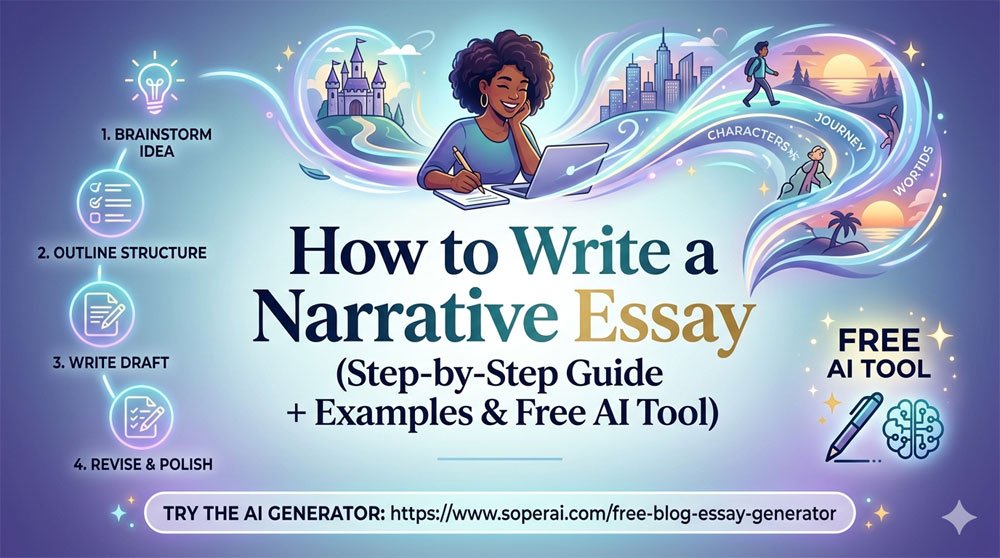
How to Write a Narrative Essay
Step-by-Step Guide + Examples & Free AI Tool
Master storytelling, structure, and style â then generate your essay instantly with AI when you need it most.
⨠Try Free AI Essay Generatorð Table of Contents
- Introduction â What is a Narrative Essay?
- Definition & Key Characteristics
- 5 Key Elements of a Narrative Essay
- Narrative Essay Structure (Step-by-Step)
- Step-by-Step Writing Guide
- Narrative Essay Examples
- Pro Tips for High-Quality Essays
- Common Mistakes to Avoid
- How AI Can Help You Write Narrative Essays
- Why Use Soperai Essay Generator?
- 10 FAQs (Rich Snippet Answers)
- Conclusion & Call to Action
Why Narrative Essays Matter â And Why They're Hard to Write
You have a story inside you. Maybe it's the night you got lost in a foreign city, the moment you stood up for yourself, or a single conversation that changed everything. A narrative essay is your chance to transform that raw experience into a piece of writing that moves, teaches, and resonates with readers.
But here's the thing â most people struggle with narrative essays, not because they lack experiences, but because they lack a system. They stare at a blank page, unsure where to begin, how to structure their story, or how to make it emotionally compelling without turning it into a messy diary entry.
That's exactly why this guide exists. Whether you're a high school student tackling your first personal essay, a college applicant crafting a Common App statement, or a blogger trying to connect with your audience, this comprehensive tutorial will walk you through every single step â from choosing a topic to polishing your final draft.
Let's dive in. By the end of this guide, you'll know exactly how to write a narrative essay that captures hearts â and you'll have a powerful free tool to back you up when inspiration runs dry.
What is a Narrative Essay?
In the simplest terms, a narrative essay is a personal story told with purpose. Unlike an argumentative essay that tries to convince readers, or an expository essay that explains facts, a narrative essay shows readers a meaningful experience through the art of storytelling.
Think of it as the midpoint between a memoir and a short story. It's real (grounded in your actual experience), but it's crafted â shaped, structured, and written with the same care a novelist would use. According to Purdue OWL, narrative essays "allow you to tell a story in an engaging way, using storytelling elements to make the writing come alive."
Storytelling Format
Uses narrative techniques: plot, conflict, dialogue, scenes, and vivid description â just like a short story.
Personal Experience
Always rooted in real events from the writer's life. First-person perspective ("I") is most common and natural.
Emotional Connection
The goal is to make readers feel something â empathy, wonder, nostalgia, or inspiration.
Central Message
Unlike a diary entry, a narrative essay has a thesis â a lesson learned or insight gained through the story.
Narrative Essay vs. Other Essay Types
| Essay Type | Purpose | Point of View | Uses Stories? | Has Argument? |
|---|---|---|---|---|
| Narrative Essay | Tell a personal story with meaning | First person (I) | â Yes | Implicit |
| Descriptive Essay | Describe a person, place, or thing | First or third | Sometimes | â No |
| Argumentative Essay | Persuade with logic & evidence | Third person | â No | â Yes |
| Expository Essay | Explain or inform | Third person | â No | Sometimes |
| Analytical Essay | Analyze a text or topic | Third person | â No | â Yes |
5 Essential Elements of a Great Narrative Essay
Every compelling narrative essay contains five core storytelling elements. Mastering these is the difference between a forgettable story and one that stays with readers for years.
ð Narrative Essay Element Importance (Based on Reader Impact)
*Based on analysis of high-scoring student narrative essays across major academic institutions.
3.1 Plot â The Story Arc
Plot is the sequence of events that makes up your story. In a narrative essay, this typically follows a classic three-act structure: a beginning that establishes context, a middle where the central conflict unfolds, and an end that resolves the situation and reveals what you learned. Even in a short essay, readers need to feel the story moving forward.
3.2 Characters â People Who Populate Your Story
Every story needs people. In a personal narrative essay, you are always the main character â the protagonist navigating a challenge or change. Supporting characters (friends, family, strangers, even adversaries) add richness and context. Give your characters distinct voices, actions, and reactions. Don't just tell us who they are; show us what they do.
3.3 Setting â Time and Place
Where and when your story happens is crucial. A well-drawn setting is more than a backdrop â it creates atmosphere and mood. "We sat in the hospital waiting room" is fine. "We sat in the waiting room under fluorescent lights that buzzed like anxious thoughts" puts your reader right there beside you. Ground your readers in sensory details: what you saw, smelled, heard, and felt.
3.4 Conflict â The Heart of the Story
Conflict is what makes a story worth telling. Without tension, there's no momentum. In narrative essays, conflict is often internal â a struggle with fear, self-doubt, grief, or a difficult decision. It can also be external â a confrontation, a challenge, or an obstacle to overcome. Ask yourself: What was the hardest part? What was at stake? That's your conflict.
3.5 Theme â The Lesson You Carry Forward
The theme is the reason you're telling this particular story. It's the implicit message that emerges from your experience. Did you learn about resilience? About forgiveness? About the gap between expectation and reality? Your theme doesn't have to be stated explicitly â in fact, the best narrative essays let the story suggest the theme, and let readers draw their own conclusions alongside you.
Narrative Essay Structure: A Complete Breakdown
Understanding the structure of a narrative essay is like knowing the blueprint of a house â once you have it, everything else falls into place naturally.
4.1 Introduction â Hook, Background & Thesis
Your opening paragraph has one job: make the reader need to keep reading. Start with a powerful hook â a dramatic scene, a provocative question, or a striking observation. Follow this with brief background that gives context, then close the introduction with a thesis statement â not a dry argument, but a sentence that hints at what this story meant to you.
Example Hook: "The moment my father's hand let go of the bicycle seat, I understood that some lessons can only be learned through falling."
4.2 Body Paragraphs â The Story Unfolds
The body is where your story lives. Organize events chronologically (or with purposeful flashbacks) and use smooth transitions to carry readers from moment to moment. Each body paragraph should advance the narrative and deepen the reader's emotional investment. Use sensory language â sight, sound, smell, touch, taste â to make scenes feel immediate and real. Dialogue is your friend here; it breaks up narration and brings characters to life.
4.3 Conclusion â Reflection & Resonance
A weak conclusion destroys an otherwise great essay. Don't simply summarize what happened. Instead, reflect: What changed in you? What do you now understand that you didn't before? Your closing should feel like an exhale â the emotional and intellectual resolution of everything that came before. End with a memorable final sentence that echoes your theme.
ð Narrative Essay Structure at a Glance
| Section | % of Essay | Key Purpose | Common Techniques | Word Count (800-word essay) |
|---|---|---|---|---|
| Introduction | 10â15% | Hook the reader, set context | In medias res, question, quote | 80â120 words |
| Body Para 1 | 25â30% | Setup & Rising Action | Scene-setting, exposition | 200â240 words |
| Body Para 2 | 25â30% | Climax / Main Conflict | Dialogue, tension, pacing | 200â240 words |
| Body Para 3 | 15â20% | Falling Action | Resolution, shift in tone | 120â160 words |
| Conclusion | 10â15% | Reflection & Closing | Callback to hook, lesson | 80â120 words |
How to Write a Narrative Essay in 5 Steps
Follow these five steps and you'll go from blank page to polished essay with confidence. Each step builds on the last, so don't skip ahead.
Choose a Meaningful Topic
Pick an experience that genuinely affected you â not the most dramatic event of your life, but one where something changed. The best narrative essay topics are specific and personal. A quiet moment can be more powerful than a grand crisis.
Create a Story Outline
Before you write a single sentence of your essay, map out your story's arc. Identify your hook, the key scenes in chronological order, the climax, and the lesson or insight you want to leave readers with. An outline is your compass.
Write Your First Draft
Give yourself permission to write badly. Your first draft is about getting the story down, not getting it right. Focus entirely on narrative momentum â keep the story moving. Ignore grammar, polish, and perfection for now.
Add Sensory Details & Emotion
Once your draft exists, go back through it scene by scene. For each key moment, ask: What did I see? What did I hear? What did my body feel like? Replace vague statements ("I was nervous") with specific sensory details ("My palms were wet against the podium's edge").
Edit, Proofread & Polish
Read your essay aloud â your ear catches what your eye misses. Look for places where the pacing drags, transitions feel abrupt, or the language is generic. Then fix grammar, spelling, and punctuation. Consider using Soperai's AI tool to check and improve your draft.
Topic Ideas for Your Narrative Essay
| Category | Topic Idea | Emotional Core | Difficulty |
|---|---|---|---|
| ð Achievement | The day I finally passed my driving test after three failures | Perseverance | Easy |
| ð Loss | Learning to cook from my grandmother before she forgot my name | Grief & Memory | Moderate |
| ð Travel | Getting stranded alone in a city where I didn't speak the language | Fear & Self-reliance | Easy |
| ð¤ Relationships | The conversation that repaired a five-year friendship | Forgiveness | Moderate |
| ð Change | My first week in a new country as an immigrant child | Identity & Belonging | Advanced |
| â¡ Turning Point | The moment I realized my dream job wasn't what I wanted | Clarity & Courage | Moderate |
Narrative Essay Examples (Short & Full)
Reading good examples is one of the fastest ways to internalize what a narrative essay should feel and sound like. Here's a sample introduction paragraph and a complete mini-essay so you can see the techniques in action.
Example 1: Powerful Opening Paragraph
The bicycle teetered as I pedaled faster, my father's voice trailing behind me like a ribbon in the wind. "You've got it! Keep going!" I heard him shout â but when I turned to look, I saw something I hadn't expected: he had let go of the seat a full block ago. In that moment, as the ground blurred beneath my wheels and my heart seized with a terror that somehow felt like joy, I understood what it meant to trust yourself before you feel ready. Some of life's most essential lessons, I would later come to know, are delivered not in classrooms, but in the seconds before you realize you're already flying.
Example 2: Complete Mini Narrative Essay (~400 words)
Introduction: My grandmother's kitchen smelled of cardamom and burnt sugar every Sunday morning. For twenty-three years, that smell meant safety. Then, one November morning, she looked at me across the breakfast table and asked me, very politely, who I was. I had known, intellectually, that Alzheimer's would take her. I hadn't known it would happen on a Sunday, over tea, in that kitchen that smelled like everything I had ever loved.
Body â Rising Action: We had started cooking together the previous year, when her memory was still mostly intact but beginning to fray at the edges. I wrote down every recipe she knew by heart â biryani, haleem, sheer khurma â as she dictated from her stool near the window. She remembered the spices perfectly. She sometimes forgot my name. I told myself that as long as she could cook, she was still there.
Body â Climax: That November morning, when she looked at me without recognition, I didn't break down. Instead, I stood up, walked to the stove, and began making her tea the way she had taught me: two cardamom pods, one star anise, milk first, then water. When I set the cup in front of her, she wrapped both hands around it and said, "You make it just right." She didn't know who I was. But the tea remembered.
Conclusion: I carry that morning with me now. I think about it whenever I'm tempted to define love through recognition â through being remembered. My grandmother taught me every recipe she knew. She also taught me, in the end, that love can outlast the brain that held it. Some things live in the hands. Some things survive every forgetting. And sometimes, the deepest proof that someone shaped you is not that they recall your name, but that you carry their warmth into every room you enter.
7 Pro Tips for Writing a Memorable Narrative Essay
These tips separate good narrative essays from unforgettable ones. Apply even two or three and you'll see an immediate difference in the quality and power of your writing.
Show, Don't Tell
"I was scared" tells. "I couldn't feel my fingers on the door handle" shows. Readers want to experience your story, not be narrated at.
Use Dialogue
Real conversations break up narration and create immediacy. Even one or two lines of dialogue can make a scene feel three-dimensional.
Start in the Middle of Action
Don't write "I was born in Karachi." Drop readers into a scene. In medias res (starting in the middle of action) is the most powerful way to open a narrative essay.
Create a Callback
Echo an image or phrase from your opening in your conclusion. This creates a satisfying sense of closure â the essay feels complete and intentional.
Stay Specific
Specificity = credibility. "We drove for a long time" is weak. "We drove for four hours through flat Kansas farmland" is vivid and believable.
Keep It Authentic
Readers can sense when a writer is performing emotion rather than expressing it. Write honestly, even when (especially when) the truth is complicated.
Balance Scene & Summary
Not every moment needs to be fully dramatized. Alternate between fully-rendered scenes (for crucial moments) and brief summaries (to bridge time).
Common Mistakes That Ruin Narrative Essays
Knowing what not to do is just as valuable as knowing what to do. Here are the most common narrative essay mistakes â and how to fix each one.
| Mistake | Why It's a Problem | The Fix | Severity |
|---|---|---|---|
| ð« No clear structure | Story feels disjointed; readers get lost | Use an outline before writing. Follow intro â conflict â resolution | High |
| ð« Too much telling, no showing | Essay feels flat and emotionally distant | Replace every "I felt X" with a physical sensation or action | High |
| ð« Weak or rushed conclusion | Destroys all the emotional build-up you created | Spend as much time on your ending as your beginning | High |
| ð« Starting too early in the story | Buries the reader in irrelevant backstory | Start close to the central moment; give only essential context | Medium |
| ð« No clear theme or message | Story entertains but doesn't resonate or linger | Ask yourself "So what?" â then make that your thesis | Medium |
| ð« Grammatical errors throughout | Undermines credibility and breaks reading flow | Read aloud, use grammar tools, or try Soperai AI | Medium |
| ð« Trying to cover too much ground | Essay becomes a list of events, not a focused story | Choose ONE experience, ONE lesson, ONE central conflict | Low-Medium |
â Before (Weak Version)
"I was really nervous before my first speech. I walked up to the stage and felt bad. I did the speech and it was okay in the end. I learned that I shouldn't be nervous."
â After (Stronger Version)
"My knees barely held as I climbed the three steps to the stage. Two hundred faces looked up at me, and for a moment all I could hear was my own heartbeat. I had prepared for three weeks. None of that preparation had included this: the vertiginous realization that I was, irrevocably, here."
How AI Can Help You Write Better Narrative Essays
Artificial intelligence has changed the way students, bloggers, and professionals approach writing. When used thoughtfully, AI tools don't replace your voice â they amplify it. Here's exactly how AI can support your narrative essay writing process at every stage.
Instant Idea Generation
Stuck on what to write about? AI can suggest narrative essay topics tailored to your interests, experiences, or assignment prompts in seconds. No more blank-page paralysis.
Automatic Structure
AI generates a complete outline and first draft with proper narrative essay structure â introduction, body paragraphs, and a reflective conclusion â so you have something concrete to work with immediately.
Style & Grammar Polish
AI tools can identify grammar errors, awkward sentences, weak transitions, and passive voice â then suggest stronger alternatives that make your writing sound more natural and professional.
Saves Hours of Time
What takes most writers 3â5 hours â from ideation to first draft â AI can deliver in under two minutes. You spend your time refining and personalizing, not staring at a blank screen.
â±ï¸ Time Spent on Narrative Essays: Manual vs. AI-Assisted
Ready to Write Your Narrative Essay Instantly?
Instead of spending hours staring at a blank page, generate a complete, well-structured narrative essay in seconds â completely free.
⨠Generate My Essay Now â It's Free ð§ Explore All Free AI ToolsWhy Use the Soperai Essay Generator?
Thousands of students, bloggers, and freelancers use Soperai every day to speed up their writing without sacrificing quality. Here's what makes it stand out from the crowd.
100% Free
No credit card required. No subscription needed. Generate unlimited essays at zero cost.
Instant Results
Get a complete, structured narrative essay in under 60 seconds. No waiting, no delays.
Beginner Friendly
No writing skills or AI experience required. Just type your topic and click generate.
Properly Structured
Every essay follows standard academic narrative structure: hook, body, reflective conclusion.
Built for Students
Ideal for high school assignments, college applications, and university essays worldwide.
Editable Output
Use the generated essay as a draft. Add your personal voice, experiences, and details.
Soperai vs. Other Essay Tools
| Feature | Soperai | ChatGPT (Free) | Jasper AI | EssayBot |
|---|---|---|---|---|
| Cost | Free | Free (Limited) | Paid ($49/mo) | Freemium |
| Essay-Specific Mode | â Yes | â No | Partial | â Yes |
| Narrative Structure | â Built-in | Manual prompting | Partial | Basic |
| No Account Required | â Yes | â Account needed | â Account needed | â Account needed |
| Speed | ~30 seconds | ~2 minutes | ~1 minute | ~1 minute |
| Student Friendly | â Optimized | Moderate | Business-focused | Moderate |
10 Frequently Asked Questions About Narrative Essays
These are the most common questions students and writers ask about narrative essays â answered clearly and completely for rich snippet optimization.
Your Story Deserves to Be Told Well
Writing a narrative essay is one of the most rewarding forms of writing there is â because at its heart, it's the practice of making sense of your own life. Every experience you've had, every challenge you've navigated, every moment that made you stop and think: all of it is material for a story worth telling.
Let's quickly recap everything you've learned in this guide:
- A narrative essay is a personal story told with purpose, structure, and emotional depth.
- The five key elements â plot, character, setting, conflict, and theme â are your building blocks.
- Structure your essay into a strong hook introduction, well-paced body paragraphs, and a reflective conclusion.
- Follow the five-step writing process: topic â outline â draft â details â edit.
- Use pro techniques like "show don't tell," dialogue, sensory language, and callbacks.
- Avoid common mistakes: no structure, weak conclusions, too much telling, grammar errors.
- AI tools like Soperai can dramatically speed up the writing process without sacrificing quality.
Now it's your turn. Take that experience you've been carrying â the one that made you who you are â and put it on the page. If you want a head start, use our free AI tool to generate a structured draft in seconds, then pour your own voice and memories into it.
Also explore: Soperai Home · Free AI Tools · Essay Generator · Purdue OWL Narrative Essays · UNC Writing Center