Table of Contents
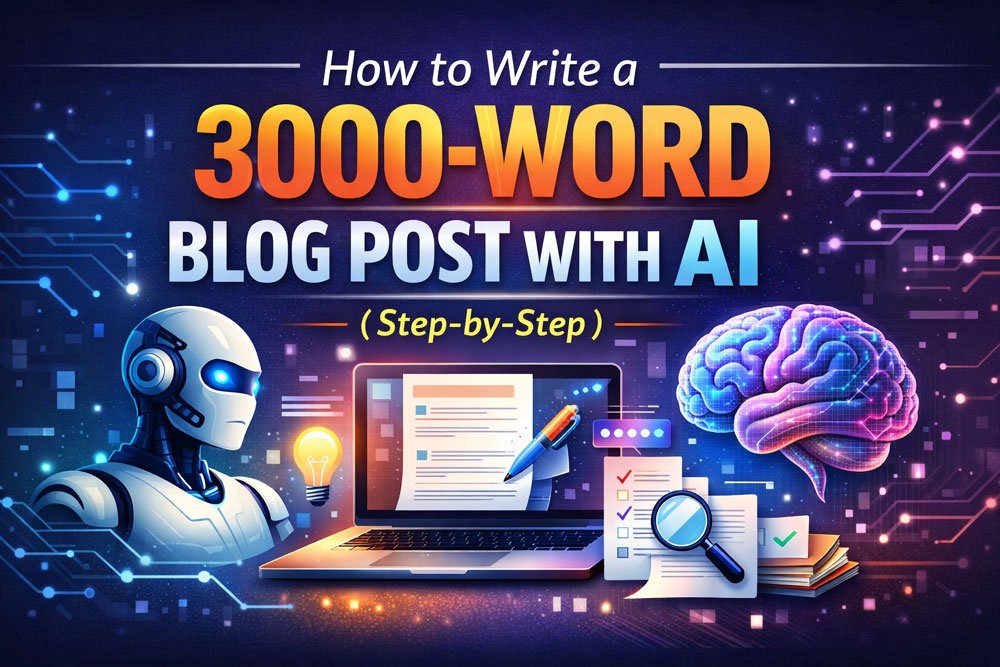
Can AI Really Write a 3,000-Word Blog Post?
Let's start with honesty. You've probably heard someone say "I just got ChatGPT to write my whole blog post in 30 seconds." And maybe you've tried it, hit the generate button, skimmed what came back, and thought: this is fine, I guess. "Fine" isn't going to rank. "Fine" isn't going to build an audience. And "fine" is exactly what you get when you treat AI like a magic button instead of a powerful writing partner.
The people publishing outstanding AI-assisted content — the posts that rank on page one, earn shares, and build genuine authority — are doing something different. They're running a structured, human-in-the-loop workflow where they guide the AI, review every section, inject their own expertise, and polish the final product before it ever sees a publish button.
A 3,000-word blog post that used to take 6–8 hours of deep focus can now be done in 60–90 minutes using the right process. That's not an exaggeration — it's the reality for thousands of content teams, agency writers, and solo bloggers who've adopted the AI-assisted workflow we're walking through in this guide.
Throughout this guide, we'll be using Soperai.com as the featured platform — a tool with access to 300+ AI models built specifically for end-to-end blog generation. We'll also cover exact prompts, SEO checklists, humanisation techniques, and a complete workflow you can start using today.
AI vs Traditional Writing — 3,000-Word Post Time Breakdown
Up to 87% time saving with a structured AI workflow
This guide is your step-by-step roadmap. By the time you finish reading, you'll have a repeatable process you can use every single week — producing high-quality, SEO-optimised 3,000-word posts at a pace that would have been impossible without AI.
Why 3,000 Words? The SEO Science Behind Blog Length
Here's a question every blogger faces at some point: does length actually matter, or is it just a vanity metric people argue about on Twitter? The answer, backed by real data, is nuanced but decisive: for competitive informational keywords in 2025, longer posts win more often than not.
Backlinko's analysis of 912 million blog posts found that longer content earns significantly more backlinks than shorter content. Their data shows the sweet spot for earning referring domains sits between 2,500 and 3,500 words. Similarly, Ahrefs research consistently shows that the average first-page result is over 2,000 words — and for head-term competitive queries, top-ranked posts frequently exceed 3,000 words.
The reason is simple: a 3,000-word post gives you space to fully answer the search query, cover related subtopics, include semantic keywords naturally, build internal linking opportunities, and demonstrate genuine expertise. Google's algorithms have become very good at identifying posts that comprehensively satisfy a user's information need — and a well-structured 3,000-word post has a structural advantage over a 800-word overview.
Word Count vs Google Page-1 Ranking Probability
Based on aggregated research from Backlinko, Ahrefs & HubSpot · Illustrative figures for competitive informational queries
When Is 3,000 Words the Right Target?
The 3,000-word format works best for comprehensive how-to guides, ultimate resource posts, detailed comparisons, in-depth explainers, and pillar content pages that anchor a topical cluster. It's the ideal length when your target keyword is competitive, when users are searching to deeply understand something, or when you want to build a resource that earns backlinks over time.
That said, don't pad for the sake of it. Every paragraph in a 3,000-word post should earn its place by adding something useful. AI makes this easier than manual writing — when prompted correctly, it adds depth and supporting detail without repeating itself or filling with fluff.
Pro Tip: AI makes hitting exactly 3,000 words consistent and precise. With manual writing, you either run out of things to say at 1,800 words or spiral into rambling at 4,000. With the section-by-section AI approach in Step 3 of this guide, you set section-level targets and the model hits them every time.
Choose Your Topic and Target Keyword
Every great blog post starts with knowing exactly what you're writing about and why. Before you open a single AI tool, you need a clear primary keyword and a solid understanding of the search intent behind it. Skipping this step and jumping straight to AI generation is the number one reason AI-assisted blog posts fail to rank.
Think of keyword research as briefing a very talented writer who happens to know nothing about your niche or your audience. The better you brief them, the better the output. For a 3,000-word post specifically, you'll want not just a primary keyword, but a full semantic keyword map — the cluster of related terms, subtopics, and questions that your post should answer.
Start with Search Intent, Not Just a Vague Idea
Search intent is the why behind a query. Google has broadly categorised intent as informational (learn), navigational (find), commercial (compare), and transactional (buy). Your 3,000-word post needs to match the intent of your target keyword perfectly, or even the best AI-generated content will fail to rank.
Free and Paid Keyword Research Tools
You don't need a $400/month SEO suite to find keywords worth writing about. For a 3,000-word blog post, look for primary keywords with 1,000–10,000 monthly searches, a keyword difficulty below 50 (in Ahrefs or SEMrush), and at least 3–5 questions or subtopics you can naturally cover at length.
Building Your Semantic Keyword Map
For a 3,000-word post, you need more than one primary keyword. You need a full semantic map of 8–12 related terms that tell the AI exactly what territory to cover. Here's an example map for a post targeting "write blog post with AI":
Generate a Detailed Blog Outline with AI
A 3,000-word blog post without a solid outline is like trying to build a house without blueprints. You might end up with something that stands, but it won't be efficient, it won't be beautiful, and it definitely won't rank. The outline is the single most important document in your entire writing workflow — and AI can generate an excellent one in under four minutes.
Soperai's complete blog generator automatically structures H1, H2, and H3 hierarchy and suggests section-level word counts that add up to your target of 3,000 words. It also ensures your primary and LSI keywords appear in heading positions — a factor Google uses to understand topical relevance.
The 3,000-Word Outline Prompt Formula
"Create a detailed blog outline for a 3,000-word post titled [TITLE]. Include H2 and H3 headings, a hook intro (220 words), a detailed body covering all key subtopics (2,400 words across 6–8 H2 sections), and a conclusion with CTA (380 words). Target keyword: [KEYWORD]. LSI keywords to distribute: [YOUR LSI LIST]. Target audience: [DESCRIBE READER]. Include a 5-question FAQ section for featured snippet targeting."
Editing and Approving Your Outline
Never take the AI outline straight to drafting without reviewing it first. Even the best generated outline will have one or two generic sections you should sharpen, and it won't know the unique angles you want to bring from your own experience. Spend five minutes reviewing with these questions in mind, and you'll get a dramatically better final post:
Outline Review Checklist
Write the First Draft Section by Section
This is the step where most people go wrong. They paste their entire outline into the AI with "write this as a 3,000-word blog post" and hit send. The AI complies, and what comes back is technically 3,000 words — but it reads like a generic Wikipedia article written by a robot who has never actually done the thing being described. Flat. Predictable. Unmemorable.
The professional approach is section by section. You write one H2 block at a time — 300–500 words — review it, adjust tone and specific angles, then move to the next. This keeps the AI focused on a single task, gives you fine-grained control over the output, and makes the editing process infinitely more manageable. For a 3,000-word post, you're looking at 7–9 section-level prompts, which takes about 12–18 minutes total.
Section-Level Prompt Template for 3,000-Word Posts
"Write the [SECTION NAME] section of my blog post about [TOPIC]. Target word count: ~[N] words. Tone: [conversational/authoritative/friendly]. Target reader: [AUDIENCE DESCRIPTION]. Avoid generic advice — be specific and practical. Include the following LSI keywords naturally: [2–3 LSI TERMS]. End the section with a smooth transition sentence into the next topic: [NEXT SECTION NAME]."
Choosing the Right AI Model for Your Niche
One of Soperai.com's most powerful advantages is access to 300+ AI models — not just one. Different models genuinely produce different quality outputs for different niches, and learning to match the right model to your content type will give your 3,000-word posts a noticeable quality edge.
With Soperai's best AI text generation tools, you can switch between models mid-session and compare outputs side by side. For a fashion blog you might prefer GPT-4o's conversational flair. For a technical SaaS guide you'd likely choose Claude 3.5. The ability to match model to niche — across 300+ options — is one of the key reasons serious content teams use Soperai over single-model tools.
Write a High-Converting Intro and Conclusion
The intro and conclusion are the most important 600 words in your 3,000-word post — and they're often the most neglected. AI-generated intros have a bad habit of starting with "In today's digital world..." or "Are you looking for ways to...?" These openers are so generic they actively damage your credibility before the reader has even had a chance to decide if they like your content.
A 3,000-word post can afford a richer, more nuanced intro than a short post — aim for 200–250 words that pull the reader in, set the scene clearly, and make a specific promise about what the next 2,800 words will deliver. The conclusion should be proportionally strong: 300–380 words that summarise the key insights and drive a clear next action.
Hook Generation Prompt
"Write 3 alternative hooks for a 3,000-word blog post about [TOPIC]. Each hook must be different: (1) a surprising industry statistic, (2) a direct second-person question that addresses a real pain point, (3) a bold contrarian claim that challenges conventional wisdom. Each hook should be 2 sentences maximum and leave the reader wanting to read more."
CTA Options for Your Conclusion
Edit, Humanise, and Add Your Voice
A 3,000-word AI draft is a first draft — full stop. It is not a published article. If you upload it unchanged, you'll produce content that looks and feels like the thousands of other AI-generated posts Google sees every day — and increasingly, Google's algorithms are very good at identifying surface-level AI content that was never meaningfully edited.
The editing step is where you transform AI output into genuinely useful content. It's where your expertise, your personality, your real-world examples, and your brand voice come in. A 3,000-word post gives you more space to add these human layers than a short post — and that's an advantage. Use it.
For a 3,000-word post, expect to spend 30–40 minutes on humanisation editing. That's your investment in the quality that makes the difference between a post that ranks and one that doesn't. Here's exactly what that editing pass should look like:
The 5-Point Humanisation Checklist
Google's Helpful Content Update and 3,000-Word AI Posts
Google's Helpful Content guidelines do not penalise AI writing. What they penalise is low-effort, unedited AI content that exists purely to capture search traffic without offering genuine value to a real human reader. The distinction is clear: if your 3,000-word post was produced with care, edited to add expertise, and actually helps someone accomplish something or understand something, it will rank regardless of how it was drafted.
The meta-prompting technique is also worth knowing for the editing phase: paste any section you're unhappy with back into Soperai and say "Rewrite this paragraph to sound more conversational, add a specific example, and remove the generic phrasing." You get a new version in seconds without starting from scratch — and iteration is where AI-assisted writing really shines for longer posts like this.
Optimise for SEO Before Publishing
You've written a well-structured, humanised 3,000-word post. Now make sure Google can find it, understand it, and rank it. On-page SEO for a longer post requires more attention than a short article — there are more headings to optimise, more internal linking opportunities, and more places where your keyword distribution needs to be balanced rather than front-loaded.
The good news: AI handles the on-page SEO layer well when you use the right prompts. Soperai's complete blog generator automatically ensures heading structure, keyword distribution, and meta data are handled from the start — but it's still worth doing a final manual check with this checklist before you hit publish.
On-Page SEO Checklist — 3,000-Word Posts
Meta Title & Description Prompt
"Write 3 meta title options for a blog post titled [TITLE]. Each must be under 60 characters, include the keyword [KEYWORD], and create curiosity or urgency. Then write 2 meta description options (150–160 characters each) that include the keyword, mention a specific benefit of reading, and include a soft call to action."
Soperai.com Deep Dive — Why It Stands Out
There are dozens of AI writing tools competing for your attention in 2025. Most of them are wrappers around one or two models with a polished interface and a monthly subscription. They're convenient, but they lock you into a single AI's capabilities, personality quirks, and pricing model — which is a significant limitation when you're producing 3,000-word posts at scale across multiple niches.
Soperai.com is built on a fundamentally different philosophy: give content creators access to 300+ AI models in a single dashboard, and let them choose the exact model that's best for their specific content goal on any given day. For a serious 3,000-word blog post, that flexibility is a genuine competitive advantage.
300+ AI Models in One Dashboard
Access GPT-4o, Claude, Gemini, Llama, Mistral, Cohere and hundreds more. Switch models per project. No other platform offers this breadth for blog writing specifically.
Complete Blog Generation
Topic input → outline → 3,000-word draft → meta data → FAQ — all in one workflow. See Soperai's complete blog generator for the full end-to-end experience.
SEO-Optimised From the Start
Structured headings, keyword placement, meta data, and internal linking suggestions are built into every output by default — not bolted on as an afterthought.
AI Social Media Tools
Repurpose your 3,000-word blog post with AI-Powered Social Media Tools and AI Instagram caption generator. One post becomes a week of social content.
Single-Dashboard Workflow
No more jumping between ChatGPT for drafting, Jasper for templates, and a separate SEO tool. Soperai handles the full 3,000-word workflow in one place.
Built for Teams and Agencies
For content agencies managing 50+ posts per month, Soperai's multi-niche model selection means you're never compromising on output quality for any client vertical.
Soperai vs Other AI Writing Tools
Complete Workflow Checklist (Bookmark This!)
Run through this checklist every time you write a 3,000-word AI-assisted blog post. Once this process becomes habit, you'll produce high-quality, publication-ready long-form content with remarkable consistency — and in a fraction of the time it used to take.
Frequently Asked Questions
11 questions answered — structured with FAQ schema for Google featured snippets