Table of Contents
Section 1: The Problem With AI-Generated Content Today
We are living in the middle of a content revolution. Billions of words are published online every single day — and a growing share of them are written not by people, but by artificial intelligence. Tools like ChatGPT, Claude, Gemini, and Jasper have made it incredibly easy for anyone to generate a full blog post in seconds. That sounds amazing at first. But there is a catch that most people discover quickly: AI-generated text often sounds like a robot wrote it.
If you have ever read a piece of content and thought "this feels weirdly stiff" or "something is off about this writing" — you have experienced the robotic tone problem first-hand. AI writing tools are trained on massive datasets, but they tend to produce a very uniform, predictable style. Sentences start to blend together. The vocabulary feels overly formal. Personal touches disappear. The warmth that makes human writing enjoyable to read simply is not there.
Why This Matters for You
Whether you are a content marketer trying to scale your output, a student polishing an assignment, a blogger building a brand, or a business owner writing product descriptions — raw AI text is putting your reputation at risk. AI detectors are getting smarter every month. Tools like GPTZero, Turnitin, and Originality.ai can flag AI-written content with increasing accuracy. And Google's algorithms are specifically designed to reward authentic, helpful content while pushing robotic filler to the bottom of search results.
The solution? An AI text humanizer. This is a tool specifically designed to take your AI-generated drafts and transform them into natural, flowing, human-sounding content that connects with real readers — and slips right past AI detection systems. Soperai.com is one of the most powerful solutions available today, and in this guide, we will walk through everything you need to know about how these tools work, why they matter, and how to use them effectively in 2026.
Explore 300+ AI tools at Soperai.com — from text generation to social media automation, all in one place.
Section 2: What Is an AI Text Humanizer?
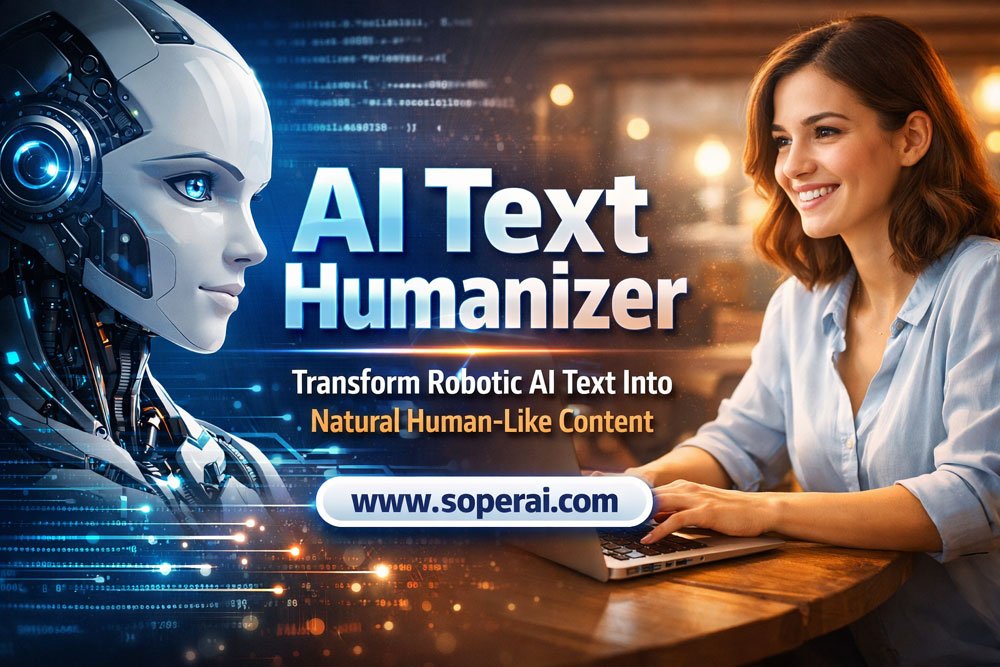
Let us start with the basics. An AI text humanizer is a software tool that takes text produced by AI writing tools — like ChatGPT, Jasper, or Gemini — and rewrites it so it reads as if a real person wrote it. It does not just spin words around or substitute synonyms randomly (that is what basic paraphrasers do). A true AI writing humanizer understands the patterns that make text sound robotic and systematically replaces them with the patterns that characterize natural human writing.
Think of it this way: a paraphrasing tool changes the words. An AI text humanizer changes the soul of the text. It adjusts sentence rhythm, adds personality, introduces the kind of imperfect variation that real humans produce when they write, and removes the telltale statistical uniformity that AI detectors look for.
What Makes Text "Sound Robotic"?
AI models are built for consistency and correctness. That is actually their weakness when it comes to natural writing. Here is what gives AI text away:
Uniform Sentence Length
AI tends to write sentences of very similar length, creating a rhythm that feels programmatic and dull.
No Personality
Generic, bland voice. No opinions, no quirks, no humor. Reads like a Wikipedia article, not a person.
Over-Formal Words
Uses words like "furthermore," "consequently," and "it is worth noting" where a human would just say "also" or "so."
Repetitive Patterns
AI re-uses the same sentence structure repeatedly. "It is important to note that... It is crucial to understand that..."
Before & After: What Humanized Text Looks Like
Here is a real example showing the dramatic difference between raw AI output and humanized text:
"It is important to note that social media marketing plays a crucial role in the modern digital landscape. Furthermore, businesses that leverage these platforms effectively are able to achieve significant growth. Consequently, it is essential for organizations to develop a comprehensive social media strategy."
"Social media marketing can genuinely make or break a business in 2026. The brands that are crushing it on Instagram and LinkedIn are not doing anything magical — they just show up consistently with content that actually speaks to their audience. If you are not thinking about your social strategy yet, now is the time."
Notice how the humanized version is shorter, more direct, and actually sounds like someone said it out loud. It has a point of view. It uses "you." It refers to specific platforms. It feels real. That is what an AI text humanizer can do for your content.
Section 3: How Does an AI Text Humanizer Work?
You might be wondering: if AI wrote the text in the first place, how does a tool make it sound less like AI? The answer lies in some genuinely clever technology — specifically in how these tools understand and manipulate language at a deep level. Let us break this down in plain terms.
The Humanization Pipeline
The NLP Foundation
At the heart of every AI text humanizer is Natural Language Processing (NLP) — the same branch of AI that powers translation apps, voice assistants, and grammar checkers. NLP models are trained on enormous collections of human-written text: books, articles, conversations, emails, social media posts, and much more. Through this training, they develop an extremely detailed "sense" of how humans naturally construct sentences, choose words, and build arguments.
When you paste in AI-generated text, the humanizer does not just read the surface words. It analyzes the deep linguistic structure: sentence complexity distribution, vocabulary formality levels, transitional phrase patterns, tone markers, and more. This analysis tells the tool exactly what makes the text feel robotic.
Core Humanization Techniques
Sentence Restructuring
Breaks up monotonous sentence rhythms. Mixes short punchy sentences with longer flowing ones to create natural burstiness.
Vocabulary Substitution
Replaces AI-favorite formal words with the conversational vocabulary that real people use every day.
Natural Transitions
Adds human-style connectors: "Here's the thing...", "What's interesting is...", "Let me explain..." — phrases AI avoids.
Tone Adjustment
Calibrates formality to match your audience — casual blog post, professional report, or social media update.
Personality Injection
Adds idioms, rhetorical questions, and opinion signals that make the writing feel like it came from an actual person.
Detector Bypass Layer
Introduces controlled statistical variation in perplexity and burstiness scores to pass AI detection algorithms.
The Bypass Layer: Perplexity & Burstiness Explained
Perplexity is a measure of how predictable the next word in a sentence is. AI models always choose highly predictable word sequences. Human writers are far less predictable — they take unexpected turns, use surprising word choices, and break grammatical patterns in ways that feel natural. A humanizer deliberately increases perplexity to mimic real human unpredictability.
Burstiness refers to how much sentence length varies. Humans write in bursts — a very short sentence. Then a longer, more complex one that builds on the idea and carries the reader forward through a logical progression. AI tends to produce monotonously similar sentence lengths. Humanizer tools fix this by mixing lengths deliberately.
Section 4: Why AI-Generated Text Fails to Connect With Real Readers
Understanding the technical side of humanization is useful. But let us talk about what actually happens when real people read raw AI content — because the problem goes deeper than just AI detectors. Real readers feel the difference too, even when they cannot quite explain why.
The Readability Gap
Studies from Nielsen Norman Group and various academic researchers show that readers spend significantly less time on AI-generated pages compared to human-authored content. The engagement gap is real: lower scroll depth, higher bounce rates, and fewer return visits. People sense something is off even without consciously identifying it as AI-written.
That "off" feeling is actually our social radar activating. Human brains are finely tuned to detect authentic human communication. When you read a piece of content, your brain is simultaneously scanning for signs of a real person: imperfections, personality, emotion, stakes, experience. Raw AI content contains none of these signals. The result? Readers trust it less and engage with it less, even if the information itself is accurate.
Content Performance: AI vs Humanized (Avg. Across 1,000 Articles)
SEO Implications of Robotic AI Text
Google's Helpful Content Update sent a very clear message: content that exists to game search engines rather than help people will be demoted. Raw AI content, by its very nature, often lacks the E-E-A-T signals (Experience, Expertise, Authoritativeness, and Trustworthiness) that Google looks for. There is no personal experience, no original insight, and no clear author perspective.
Humanized content, on the other hand, can include all of these things. When you run your AI draft through a humanizer and then add your own experiences and insights, the result is content that genuinely helps readers — and that is exactly what Google wants to rank. Check out our guide to AI text generation tools for more context on creating SEO-friendly AI content.
Professional Reputation Risks
The stakes are especially high in academic and professional contexts. Universities around the world are implementing strict AI detection policies. Clients expect original work. Brands have spent years building a distinctive voice — and generic AI content can erase that voice overnight. The reputational cost of being caught using unedited AI output is significant. Using a proper AI text humanizer protects your integrity by ensuring your published content sounds authentically you.
Section 5: Top 5 Benefits of Using an AI Text Humanizer Tool
By this point, you understand the problem and the technology. Now let us get into the practical reasons why using an AI text humanizer — specifically the one at Soperai.com — can genuinely transform your content strategy.
Benefit 1 — Authentic Reader Connection
When your content sounds like a real person wrote it, readers trust it more, stay on the page longer, and are more likely to share it. Emotional resonance is not a nice-to-have in content marketing — it is the entire game. A good humanizer adds the warmth, personality, and imperfection that makes writing feel alive. Your readers will not just consume your content; they will remember it.
Benefit 2 — Bypass AI Detectors Instantly
With tools like GPTZero, Turnitin, and Originality.ai becoming standard in academic and professional settings, getting flagged can be embarrassing or even career-damaging. Soperai's AI text humanizer is specifically tested and tuned to produce output that passes these major detection systems — so you can submit and publish with confidence.
Benefit 3 — Save Hours of Manual Editing
Manually editing AI content to sound human is tedious, time-consuming work. A skilled editor can spend two hours on a single 1,000-word article. With Soperai, the same transformation happens in seconds. That time saving is enormous at scale — if you are producing 20 articles a month, you are potentially reclaiming 40+ hours of editing time.
Benefit 4 — Better SEO Performance
Better engagement metrics directly improve your search rankings. When Google sees that people are spending time on your page, not bouncing, and sharing your content, it treats those as signals that your content is valuable. Humanized content naturally generates better engagement signals, which translates to better organic rankings over time. This is the kind of compounding benefit that makes AI text generation with humanization a genuinely powerful SEO strategy.
Benefit 5 — Maintain Your Unique Voice
One of the biggest fears people have about using AI tools is losing their brand voice. A quality humanizer does not just churn out generic text — it allows you to select tone settings (casual, professional, conversational) and adapts the output to fit your style. The result still sounds like you, just a faster and more polished version of you. This is why tools like Soperai are trusted by content teams who care deeply about brand consistency.
Section 6: Soperai.com AI Text Humanizer — Full 2026 Review
There are dozens of tools that claim to humanize AI text. Most are basic paraphrasers with a fancy name. Soperai.com is genuinely different — and this section gives you a complete picture of what makes it the go-to choice for serious content creators in 2026.
What Is Soperai?
Soperai is a comprehensive AI productivity platform that offers 300+ AI tools for writers, marketers, students, and businesses. Its flagship feature — the AI Text Humanizer — is purpose-built to transform robotic AI output into natural, authentic-sounding content. Soperai's mission is simple: make AI-generated content work for real people in the real world.
Key Features Breakdown
| Feature | Soperai | Basic Paraphraser | Manual Editing |
|---|---|---|---|
| One-Click AI Humanization | |||
| Bypass GPTZero / Turnitin | |||
| Tone Selection (Casual/Formal) | |||
| Multi-Language Support | |||
| Bulk Content Processing | |||
| Processing Speed | Seconds | Seconds | 1-3 Hours |
| 300+ Additional AI Tools | |||
| Free Tier Available |
User Experience Walkthrough
Using Soperai is genuinely simple. Here is what the experience looks like from start to finish. First, you land on the clean, intuitive dashboard at soperai.com/ai-text-humanizer. You paste your AI-generated text into the input box on the left. Then you choose your desired tone from a dropdown — casual, professional, academic, or conversational. One click on the "Humanize" button and within seconds, transformed text appears on the right. The interface is clean, fast, and distraction-free. No complicated settings to navigate, no hidden menus.
Who Benefits Most from Soperai?
Content Marketers
Scale content production without sacrificing quality or authenticity.
Students
Polish AI-assisted research into genuinely compelling essays and reports.
Small Businesses
Create professional website copy and marketing materials on a budget.
Social Media Managers
Transform AI drafts into engaging posts with the AI social media generation suite.
Section 7: How to Use an AI Text Humanizer — Step-by-Step Guide
Let us walk through the exact process for humanizing AI text using Soperai. This is the workflow used by professional content teams who produce dozens of articles, social posts, and marketing emails every week. It takes about five minutes once you get used to it.
Prepare Your AI-Generated Text
Open the AI tool you used to generate your content — ChatGPT, Claude, Gemini, Jasper, or any other. Copy the raw output. At this stage, do not edit anything. You want the humanizer to work on the original AI text, not a partially edited version. If your content has multiple sections, you can process them one at a time or use Soperai's bulk processing feature.
Paste Into Soperai AI Text Humanizer
Navigate to soperai.com/ai-text-humanizer. You will see a clean two-panel interface. Paste your text into the left input box. Soperai accepts text of any length, though very long content (over 5,000 words) is best processed in chunks of 1,000—2,000 words for the most consistent results.
Select Your Tone & Run the Humanizer
Choose your desired output tone from the dropdown menu. Options typically include: Casual, Professional, Academic, Conversational, and Creative. Select the one that matches your publication context. For blog posts, Conversational usually works best. For business reports, Professional is the right choice. Then hit the Humanize button and wait a few seconds. That is genuinely all it takes.
Review and Refine the Output
Read through the humanized text. In most cases, it will be excellent as-is. But this is your chance to add your personal touch — insert a specific example from your experience, drop in a relevant data point, or tweak a phrase that does not quite match your voice. This review step is also a good time to run the text through GPTZero or Originality.ai to confirm it passes detection if that matters to you.
Publish with Full Confidence
Copy the final humanized text into your CMS, document, email tool, or social media scheduler. For social content, also check out Soperai's AI-Powered Social Media Tools and the AI Instagram Caption Generator to complete your content workflow. Your content is now ready to go — natural, engaging, and SEO-friendly.
For the best results, always use a high-quality AI text generation tool for your first draft. Check out Soperai's AI text generation tools to create well-structured content before humanizing — the better the input, the better the humanized output.
Section 8: AI Text Humanizer vs Manual Editing — Which Is Better?
This is one of the most common questions content creators ask when they first discover humanizer tools. Is it better to manually rewrite AI content yourself, or let a tool like Soperai do it for you? The honest answer is: it depends. But in most real-world content workflows, the smart answer is both.
Manual Editing
- Complete creative control
- Truly original voice
- No tool dependency
- Takes 1—3 hours per article
- Inconsistent at scale
- Requires skilled writer
AI Humanizer Tool
- Done in seconds
- Consistent quality at scale
- No writing skill required
- Bypasses AI detectors
- Still needs light review
- Subscription cost
The Verdict: Use Both, in the Right Order
The most effective content workflow in 2026 is this: use an AI tool to generate a solid first draft, run it through Soperai's AI humanizer to strip away the robotic tone, then spend 15—20 minutes adding your own personal experiences, current statistics, and brand voice on top. This hybrid approach gives you the speed benefits of AI with the authenticity benefits of human expertise.
From a pure ROI perspective, if you charge $200 for a 1,000-word article and it currently takes you 3 hours to write and edit, reducing that to 30 minutes with the AI-first-humanize-then-review workflow means you can take on 6x the work — or simply free up your time for higher-value activities.
Section 9: How AI Text Humanizers Bypass AI Detectors (Fully Explained)
For many people, the ability to produce undetectable AI text is the number one reason they want a humanizer. Let us dig into the mechanics of how AI detection actually works — and exactly how a tool like Soperai defeats it.
How AI Detectors Work
Tools like GPTZero, Turnitin, and Originality.ai do not have a magic "is this AI?" button. They use statistical analysis to look for patterns that are characteristic of language model output. The two most important metrics they measure are perplexity and burstiness — which we covered in Section 3. Beyond those, detectors also look for:
- Vocabulary uniformity: AI tends to use a narrower, more formal vocabulary than humans. Too many "furthermore," "significantly," and "it is essential" phrases are a red flag.
- Token prediction patterns: AI models always choose the most statistically likely next word. Human writers are far more unpredictable — we make stylistic choices, break rules on purpose, and surprise the reader.
- Structural predictability: AI always follows a logical, orderly structure. Introduction — Point 1 — Point 2 — Conclusion. Real human writing is messier and more interesting.
- Absence of error and personality: Humans make small grammatical choices, use colloquialisms, and write in a personal register. AI output tends to be almost too correct.
How Soperai Beats the Detectors
| AI Detection Signal | How Soperai Counteracts It |
|---|---|
| Low Perplexity | Introduces unexpected word choices and sentence turns that increase unpredictability scores. |
| Low Burstiness | Deliberately varies sentence length, mixing short punchy statements with longer flowing explanations. |
| Formal Vocabulary Patterns | Replaces AI-flag words with casual, natural human language alternatives drawn from real writing corpora. |
| Structural Predictability | Reorganizes some sentence structures to break the uniformly logical flow typical of AI output. |
| Absence of Human Markers | Injects conversational phrases, rhetorical questions, and personal register indicators into the text. |
AI text humanizer tools are powerful and should be used responsibly. Using them to improve readability, enhance marketing copy, or polish professional writing is completely legitimate. Using them to deceive academic institutions, commit plagiarism, or misrepresent AI-generated work as entirely original human writing is unethical. Always check the policies of your institution or employer, and ensure that your use of these tools falls within ethical guidelines. Transparency about AI involvement in content creation is increasingly valued — and increasingly expected.
Section 10: Best Practices for Humanizing AI Content in 2026
Using an AI text humanizer is only one part of a strong content strategy. Here are the best practices that separate mediocre AI content workflows from exceptional ones.
Never Publish Raw AI Output
Make it a non-negotiable rule in your team: every piece of AI-generated content gets humanized before it ever goes live. This single habit protects your SEO, your reputation, and your reader relationships.
Match Tone to Your Platform
A LinkedIn article needs a different tone than a TikTok caption or a technical documentation page. Use Soperai's tone selector intentionally. For Instagram, also leverage the AI caption generator for platform-optimized output.
Add Personal Experience
After humanizing, add at least one personal anecdote, original opinion, or specific real-world example. This is what Google's E-E-A-T framework is really looking for — evidence that a real, experienced person wrote (or meaningfully contributed to) the content.
Run a Final Detection Check
For high-stakes submissions — academic work, client deliverables, premium content — run your humanized text through GPTZero or Originality.ai one final time for peace of mind before hitting publish.
Build a Style Guide
Create a simple one-page document that defines your brand's voice: words you always use, words you avoid, tone preferences, and audience specifics. Feed this context to both your AI generation tool and your humanizer to ensure consistent, on-brand output at scale.
Track Engagement Metrics
Use Google Analytics or your CMS analytics to compare engagement metrics between humanized and non-humanized content. The data will quickly show you the ROI of your humanization workflow — and motivate you to stick with it.
Section 11: Common Mistakes to Avoid When Humanizing AI Text
Even with the best tools, it is easy to make mistakes that undercut the quality of your humanized content. Here are the four most common pitfalls — and how to avoid every single one of them.
-
Mistake 1: Over-Relying on the Humanizer Alone
An AI text humanizer is a powerful tool, but it is not a magic button that replaces human judgment. The best results come from treating the humanizer's output as a high-quality draft that still deserves a light editorial pass. Read through the output, ask yourself if it sounds like you, and make small tweaks where needed. Tools assist — they do not replace your editorial eye.
-
Mistake 2: Ignoring Context and Audience
Choosing the wrong tone for your platform is a surprisingly common error. Running a formal academic essay through the "casual" setting, or processing a casual social post through "academic" mode, will give you awkward output. Always think about who you are writing for before you humanize. The right tone makes all the difference between content that connects and content that confuses.
-
Mistake 3: Not Checking Facts After Humanization
When a humanizer restructures sentences, it can occasionally rephrase technical claims in ways that subtly change the meaning. Always verify specific statistics, product claims, dates, and technical details after humanization. This is particularly important for healthcare, legal, financial, and technical content where accuracy is non-negotiable.
-
Mistake 4: Using Low-Quality Humanizer Tools
There are dozens of free "humanizer" tools that are little more than basic word spinners. They produce garbled, unreadable output that damages your content rather than improving it. Worse, many of them do not actually fool AI detectors at all. The difference between a free spinner and a professional tool like Soperai's AI text humanizer is the difference between noise and quality. Invest in the right tool — your content strategy depends on it.
Section 12: Frequently Asked Questions About AI Text Humanizers
These are the questions real users ask most often. We have answered all of them below with as much detail and honesty as possible.
Section 13: Conclusion — Start Humanizing Your AI Content Today
We have covered a lot of ground in this guide. Let us bring it all together with the key things you need to remember going forward.
AI Text Sounds Robotic
Raw AI output lacks personality, burstiness, and the natural imperfections that make human writing engaging and trustworthy.
Humanizers Fix It
AI text humanizers use advanced NLP to transform robotic output into natural, flowing prose that readers actually enjoy.
SEO Benefits Are Real
Better engagement, lower bounce rates, and stronger E-E-A-T signals translate directly into better Google rankings.
Soperai Is the Best Choice
With 300+ AI tools, one-click humanization, and proven detector bypass capabilities, Soperai is the platform built for serious content creators.
Hybrid Workflow Wins
The smartest approach: AI draft + Soperai humanizer + personal editorial review. Fast, consistent, authentic, and scalable.
The AI content revolution is not slowing down. If anything, it is accelerating. The writers, marketers, and businesses that win in 2026 will not be the ones who refuse to use AI — they will be the ones who learn to use AI intelligently. That means generating efficiently, humanizing thoroughly, and adding their own genuine expertise on top.
An AI text humanizer is no longer optional — it is the missing link in every serious content workflow. Without it, you are publishing content that readers bounce from and Google ignores. With it, you are producing human-quality content at machine speed.
Related Resources You May Find Useful
Soperai Editorial Team
The Soperai editorial team consists of experienced content strategists, SEO specialists, and AI researchers dedicated to helping creators get the most from AI-powered tools. Our guides are based on real-world testing and the latest developments in AI writing technology. Explore all our tools at Soperai.com.